- Key Takeaways
- Start With the Job Description
- Research the Company Beyond the Homepage
- Build a Small Library of Strong Examples
- Practice Common Questions Without Sounding Scripted
- Prepare Your Professional Story
- Handle Strengths, Weaknesses, Gaps, and Difficult Topics Directly
- Make Your First Impression Intentional
- Use Body Language Without Overthinking It
- Plan Your Arrival and Interview Logistics
- Listen Before You Answer
- Ask Questions That Help You Evaluate the Job
- Show Value Without Overselling Yourself
- Use Personality to Support Your Professionalism
- Prepare for Different Interview Formats
- Be Ready for Questions About Motivation and Fit
- Know What Not to Say
- Use Interview Resources Selectively
- Prepare
Your Resume and Supporting Material - Follow Up Professionally
- Keep the Interview in Perspective
- Further Guidance & Tools
- Next Steps
- Final Words
We may earn a commission if you click on a product link and make a purchase at no additional cost to you. For more information, please see our disclosure policy.
Last updated: September 10, 2026
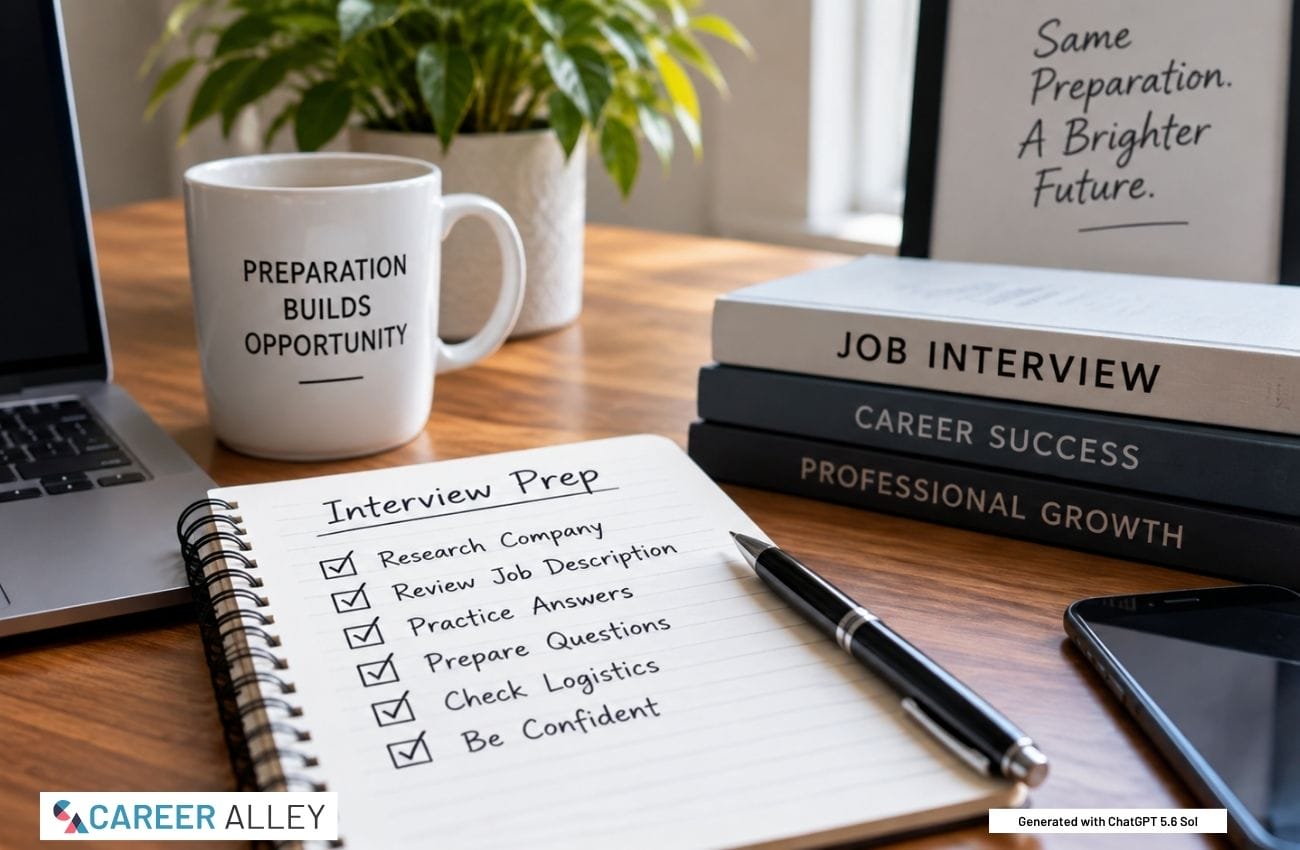
Key Takeaways
- Prepare Around Evidence: Study the employer and role, then prepare specific examples that prove you can solve the problems the organization is hiring you to handle.
- Practice Without Memorizing: Rehearse common and behavioral questions until your examples are clear, concise, and flexible enough to adapt naturally during the conversation.
- Manage the Entire Experience: Appearance, punctuality, listening, body language, technology, documents, and follow-up all contribute to the employer’s overall assessment of your professionalism.
- Treat Questions Strategically: Your questions should help you evaluate the opportunity while showing you understand the role, team, expectations, and business priorities.
- Make Fit Easy to See: Connect your skills, achievements, motivation, and career story directly to what the employer needs instead of relying on broad claims about your qualifications.
A strong
That approach matters because many employers use increasingly structured hiring processes. The U.S. Office of Personnel Management explains that structured interviews use predetermined, job-related questions and consistent evaluation standards. Candidates therefore benefit from preparing evidence tied to the competencies and responsibilities in the job rather than concentrating only on generic answers.
Interview formats also vary. You may encounter recruiter screens, panel interviews, behavioral interviews, technical assessments, telephone interviews, or video meetings before reaching a final decision-maker. Dedicated preparation for Phone interviews and preparing for Remote Interviews can help with those specialized formats, but the fundamental strategy remains the same: understand what the employer needs and prepare credible proof that you can deliver it.
Start With the Job Description
Your most useful interview-preparation document is often the job posting itself. Read it several times and identify the responsibilities, required skills, preferred experience, tools, recurring terminology, and outcomes the employer emphasizes. Reading the job description is useful because a posting often reveals far more than minimum qualifications.
Look for patterns. If project ownership appears repeatedly, prepare an example showing how you took responsibility for an important project. If customer retention, process improvement, leadership, reporting, technical expertise, or collaboration appears several times, expect those themes to influence the interview.
Do not simply repeat language from the posting. Translate the requirements into evidence. For each major requirement, write down one example from your experience that demonstrates the capability. If you lack a direct match, identify transferable experience and be prepared to explain how it applies.
Understanding deeper into the specific responsibilities can also help you distinguish between what the employer says it wants and what the person hired will actually need to accomplish.
Reviewing the role this way helps you prepare for a structured interview, where questions may be tied directly to job competencies. It also helps in less formal conversations because you already know which parts of your background deserve emphasis.
Research the Company Beyond the Homepage
Good company research should help you answer two questions: why does this employer interest you, and how could you contribute? Research the organization’s products or services, customers, competitors, leadership, recent developments, business model, values, and major challenges. Researching the company you are interviewing with gives you context to tailor your answers and decide whether the opportunity fits you.
Go beyond surface-level facts by understanding the company’s business. Try to understand what the organization is trying to achieve and what pressures may affect the team you would join.
If you know who will interview you, review their professional background. LinkedIn and company biographies may reveal how long they have been with the organization, their responsibilities, and how your prospective role relates to theirs. A resource about LinkedIn can help you think more strategically about professional profiles, while another source notes that LinkedIn can support broader job-search research.
The objective is not to impress the interviewer with trivia. Use what you learn to ask better questions and make your examples relevant. If the company is expanding into a new market, reorganizing, launching a product, or dealing with a particular industry challenge, think about how your background relates.
Ultimately, you want to understand what the company actually does well enough to have a business conversation rather than simply reciting facts from its website.
Build a Small Library of Strong Examples
Interviewers usually learn more from evidence than from adjectives. Saying that you are organized, adaptable, collaborative, analytical, or a strong leader is much less persuasive than describing something you actually accomplished.
Prepare several examples you can adapt to different questions. Useful themes include:
- A significant accomplishment and the role you personally played in achieving it.
- A difficult problem you analyzed and solved.
- A disagreement, conflict, or challenging working relationship you handled constructively.
- A mistake, failure, or setback and what you changed afterward.
- A time you influenced someone or gained support for an idea.
- A project that required leadership, teamwork, prioritization, or adaptation.
- An example that demonstrates one of the most important capabilities listed in the job description.
Behavioral interviews often ask for specific past experiences. Use the STAR method to organize those examples: explain the situation, clarify the task, describe the action you personally took, and finish with the result.
The STAR method should give your answer structure without making it sound rehearsed. Keep the situation and task brief, spend most of your time explaining your actions, and finish with a clear result or lesson learned.
Whenever possible, showcase your accomplishments with evidence such as revenue generated, costs reduced, time saved, errors prevented, customers retained, projects completed, or other outcomes relevant to your work. Numbers are useful when genuine, but not every strong result needs to be quantified.
Practice Common Questions Without Sounding Scripted
Practice helps you organize your thoughts, but memorizing long responses can backfire. A rehearsed speech may not answer the exact question asked, and losing your place can make you more anxious. Instead, remember the main points and examples you want to communicate.
Rehearse your answers to common questions about your experience, strengths, weaknesses, career goals, motivation, difficult situations, leadership, conflict, and why you want the position. Resources covering responses to key questions interviewers frequently ask can help you identify areas worth practicing.
Other preparation resources include guidance on handling challenging questions and the most common
Practice aloud. Hearing yourself answer can expose rambling, jargon, weak transitions, and stories that take too long to get to the point. Recording yourself or practicing with another person can help. The goal is not perfection; it is clarity and control.
If you are nervous about speaking, guidance on how to speak with more confidence and how to leverage both your listening and speaking skills can reinforce the communication side of
Prepare Your Professional Story
Most interviews eventually require you to explain who you are professionally. That may happen through “Tell me about yourself,” “Walk me through your background,” or a similar opening. Your answer should not be a chronological reading of
Build a short narrative connecting your recent experience, relevant accomplishments, current strengths, and reason for pursuing this opportunity. Some candidates find it useful to develop a 30-second elevator speech as a starting point.
Your actual interview answer can be longer when appropriate, but the discipline of a concise pitch prevents you from wandering through irrelevant history. Before the interview, rehearse your personal pitch. Then practice your sales pitch until it sounds conversational, not memorized.
Keep the story consistent with
Handle Strengths, Weaknesses, Gaps, and Difficult Topics Directly
Interviewers may ask about weaknesses, employment gaps, career changes, layoffs, mistakes, or other areas that make candidates uncomfortable. Preparation prevents defensiveness and overexplaining.
For weaknesses, choose something genuine that doesn’t undermine an essential job requirement. Explain what you recognized and what you have done to improve. One source frames this as Showcasing strengths honestly while addressing weaknesses constructively.
For a gap or setback, be factual and concise. Then move the conversation toward what you learned, what you did during the period when relevant, and why you are ready for the role now.
Do not attempt to create an answer so polished that it becomes unbelievable. Employers generally respond better to thoughtful self-awareness than to claims that you have never made a serious mistake or struggled with anything professionally.
Make Your First Impression Intentional
First impressions are broader than clothing. They include punctuality, preparation, communication, courtesy, energy, and whether you appear ready for the conversation. Books and resources on first impressions emphasize how quickly people form perceptions, but the practical lesson is simple: eliminate preventable distractions so the interviewer can focus on your qualifications.
Dress appropriately for the organization, role, location, and interview format. Appearance should support your credibility rather than become the focus of the meeting. If you are uncertain, it is usually safer to choose a slightly more polished version of what employees in that environment typically wear.
Sources also discuss how first impressions matter, how professional presence can make a lasting positive impression, and the importance of managing first impressions without letting appearance substitute for substance.
The standard can vary substantially between a traditional corporate employer and a startup, so research the environment rather than relying on a universal dress rule.
Use Body Language Without Overthinking It
Body language matters, but trying to choreograph every movement can make you look unnatural. Focus on a few basics: sit comfortably upright, maintain natural eye contact, listen without interrupting, avoid distracting nervous habits, and let your expression respond normally to the conversation.
Your body language should reinforce what you are saying rather than compete with it. CareerAlley also has more detailed guidance on your body language.
If a handshake is appropriate in the setting, keep it natural rather than treating it as a performance test. Older interview etiquette guidance about a proper handshake can provide context, but professional norms differ across cultures, workplaces, personal preferences, and accessibility needs.
Plan Your Arrival and Interview Logistics
Being rushed before an interview can undermine preparation you spent days completing. For an in-person interview, confirm the address, transportation, parking, building entrance, security requirements, and estimated travel time. Arrive early enough to absorb reasonable delays, but generally don’t announce yourself much earlier than necessary.
For a video interview, test the platform, microphone, camera, lighting, internet connection, screen name, background, and device power. Keep contact information available in case technology fails. A dedicated guide to prepare for phone or video interviews can help with format-specific details.
Bring whatever the employer requested. Depending on the role, that may include identification, a portfolio, work samples, references, certifications, or extra copies of
Listen Before You Answer
A strong answer begins with understanding the question. Listen to the entire question instead of constructing your response while the interviewer is still speaking. Pause briefly when you need to organize your thoughts. If the question is unclear, ask for clarification rather than guessing what the interviewer meant.
Communication is not simply about sounding confident. It includes active listening, organized explanations, appropriate follow-up questions, and knowing when you have answered enough. The National Association of Colleges and Employers identifies clear communication, active listening, appropriate questioning, and effective verbal and nonverbal communication among important workplace behaviors.
Ask Questions That Help You Evaluate the Job
The interview is also your opportunity to evaluate the employer. Prepare questions in advance, but do not rigidly work through a list if the interviewer has already covered them.
Useful areas include:
- What would success look like during the first six to twelve months?
- Which problems or priorities will require the most attention from the person hired?
- How does the team work together and make decisions?
- What distinguishes strong performers in this role?
- How will performance be measured?
- What prompted the opening?
- What are the next steps in the hiring process?
Interview resources emphasize the opportunity to ask questions, while another source explains how to ask thoughtful questions.
You can also prepare the right questions and consider what you want to learn when you have the chance to ask.
Show Value Without Overselling Yourself
Confidence is most persuasive when supported by evidence. Explain what you have accomplished and why it matters to this position. Avoid unsupported statements that you are obviously the best candidate or can solve problems you have not yet had enough information to understand.
Your task is to help the interviewer answer a practical question: can this person do the work successfully here? That means connecting your background to the employer’s priorities rather than delivering the same pitch to every company.
Resources on measurable outcomes can help you think about presenting evidence, while broader interview books explain that strong interview performance depends on preparation and communication, not confidence alone.
Use Personality to Support Your Professionalism
You do not need to turn yourself into a different person for an interview. Interviewers are assessing whether they can envision working with you, so a conversation that feels completely rehearsed can make that harder.
Answer professionally, but let appropriate personality, curiosity, and enthusiasm come through naturally. A brief relevant anecdote can make an answer memorable. Humor can work when it occurs naturally, but forcing jokes creates unnecessary risk.
Interview guidance such as Interview Like Yourself…No, Really! focuses on presenting yourself authentically rather than sounding artificial.
Prepare for Different Interview Formats
Do not assume every interview will resemble a traditional conversation with one hiring manager. The process may include telephone screens, prerecorded video questions, live video meetings, panels, technical assessments,
Structured
Some interview resources address the broader process and acknowledge how stressful interviews can be. The
Be Ready for Questions About Motivation and Fit
Expect some version of “Why do you want to work here?” and “Why this position?” A weak answer focuses entirely on what the employer can give you. A stronger answer combines genuine interest in the work, something specific about the organization, and a credible connection to your background or goals.
Do not pretend that an employer is your lifelong dream company if it is not. Specificity is more convincing than exaggerated enthusiasm. Explain what attracts you to the responsibilities, problems, team, products, customers, industry, or development opportunity.
Research can also help you decide whether you actually want the job. Interviews are not simply tests you must pass. They are opportunities to gather information before potentially making a major career decision.
Know What Not to Say
Preparation should also prevent avoidable mistakes. Do not criticize former employers at length, disclose confidential information, exaggerate qualifications, or give answers that contradict
CareerAlley has additional examples of things you should never say and common interview mistakes.
When a difficult question catches you off guard, do not rush. Ask for clarification when necessary, take a moment to think, and answer the question that was actually asked.
Use Interview Resources Selectively
Interview books, courses, coaches, and tools are everywhere. They are most useful when they solve a specific preparation problem rather than encouraging you to consume endless advice.
General interview-preparation material includes preparing for an interview, job interview preparation, and advice on making a lasting impression on your interviewer.
If answering difficult questions is your main concern, several resources focus on that part of
For broader preparation, candidates may also consider Knock ’em Dead
If you want more comprehensive preparation, additional material covers interview preparation, while another source focuses specifically on interview questions.
Some candidates also benefit from coaching or practice tools when they have repeated interviews without progressing. A resource designed to help you gain an advantage in your interview may provide additional structured practice.
Prepare Your Resume and Supporting Material
Your interview story should agree with the resume that earned you the meeting. Review it before the interview, including older positions that you may not have discussed recently. Be ready to explain responsibilities, transitions, dates, accomplishments, and career decisions.
Even when the employer already has
If
Follow Up Professionally
After the interview, send a concise thank-you message to the people who interviewed you. Thank them for their time, mention something specific from the conversation when appropriate, and reaffirm your interest if you remain interested.
Resources emphasize the importance of writing a thank you note and why sending a thank-you note can reinforce your professionalism.
Another interview-preparation source notes that following up is important, while broader guidance covers professional follow-up beyond the initial message.
A thank-you message will not rescue a poor interview, and you should not use it to repeat your entire candidacy. Its purpose is to close the interaction professionally and, when useful, briefly reinforce an important point from the discussion.
Keep the Interview in Perspective
Even excellent interviews do not always lead to offers. Employers may have internal candidates, changing budgets, different priorities, or applicants whose backgrounds more closely match a particular need. Evaluate your performance realistically rather than treating every rejection as proof that you interviewed badly.
After each interview, make brief notes while the conversation is fresh. Record questions that caught you off guard, examples that worked well, areas where you rambled, information you learned about the employer, and anything you want to improve before the next meeting.
Interview performance is a skill. Preparation, reflection, and repetition make it easier to communicate what you can do without trying to become someone you are not.
Further Guidance & Tools
- Structured Interviews: Review the U.S. Office of Personnel Management structured interview guidance to understand competency-based questions and standardized interview formats.
- Career Competencies: Use the NACE Career Readiness Competencies to identify communication, critical-thinking, teamwork, professionalism, and other skills worth supporting with examples.
- Interview Questions: Review Indeed’s interview questions guide to build a practical practice list without trying to memorize scripted responses.
Next Steps
- Analyze Role: Highlight the five most important responsibilities or competencies in the job description and match each one to evidence from your experience.
- Research Employer: Review the company, industry, interviewers, recent developments, and likely business priorities so your answers and questions reflect this specific opportunity.
- Prepare Stories: Build several concise examples covering achievement, problem-solving, conflict, leadership, failure, adaptability, and another capability central to the position.
- Practice Aloud: Rehearse common questions and your professional introduction aloud, then shorten answers that ramble or take too long to reach the point.
- Check Logistics: Confirm location or technology, clothing, documents, timing, interviewer details, and follow-up information before the day of the interview.
Final Words
The strongest
We’re with you until you land your next job — placement support guaranteed. Four expert services. One simple fee. This personal, done-for-you, job placement support service has everything you need to find your next role.


Mark Fiebert is a former finance executive who hired and managed dozens of professionals during his 30-plus-year career. He now shares expert job search, resume, and career advice on CareerAlley.com.