- Key Takeaways
- How to Approach the "Why Should We Hire You?" Question
- Focused Career / Credentials review:
- Create Your Elevator Speech:
- Body Language and Interview Skills:
- Practice Makes Perfect:
- And the Answer is (to why they should hire you) . .
- Understanding What Employers Really Want
- Preparing Evidence That Proves Your Value
- Structuring a Confident, Memorable Hiring Pitch
- Aligning Delivery, Body Language, and Follow-Up
- Further Guidance & Tools
- Next Steps
- Final Words
- Some Must-Read Books:
We may earn a commission if you click on a product link and make a purchase at no additional cost to you. For more information, please see our disclosure policy.
Last updated: November 23, 2025
Key Takeaways
- Know Employer Needs: Interviewers ask why they should hire you to assess whether you understand their priorities and can clearly connect your skills to their immediate challenges.
- Show Proof of Value: Specific, quantified examples of past achievements create a more substantial impact than general traits and help demonstrate how you can contribute quickly in the new role.
- Prepare Your Pitch: Structuring your answer with clarity and purpose ensures you sound confident, focused, and aligned with the organization’s actual needs for the position.
- Practice Delivery: Refining your tone, pacing, and body language allows you to present your message naturally and reinforces the professionalism employers expect during interviews.
- Align and Follow Up: Supporting your interview statements with consistent nonverbal cues and a thoughtful thank-you message strengthens your credibility and final impression.
How to Approach the “Why Should We Hire You?” Question
“Why should we hire you?” is a common question that is often asked during an interview (as are the variations – Why are you the best candidate, How would you fit into our team, etc.). Most job seekers consider this one of the most dreaded questions. So how on earth do you answer that question adequately? The key to this is to frame your

Optimize your job search in minutes with 18 powerful tools
Build a standout resume, tailor it to every role, discover jobs you’ll love, and apply with one click — all in one place. Perfect for self-starters who want speed and flexibility.

Focused Career / Credentials review:
It will be easier to answer this question if you’ve done some homework (on yourself). Make Some Lists:
- Your strengths and weaknesses
- Jobs you are qualified to apply for based on your experience and education
- Your accomplishments (including statistics, such as “saved $10,000 for the company”
- Promotions (and why you were promoted)
- Problems you’ve solved at work
- Review Your Lists: Take the key components from each of your lists – these are some of the reasons why you should be hired.
Create Your Elevator Speech:
Your elevator speech is your short marketing speech (your
- Focus on the core of your experience (why a hiring manager should consider you for the position).
- Speak to your top 3 accomplishments in your career (include the benefit-cost savings, etc.) and how they relate to the position.
- Define the purpose (what are you trying to achieve).
- Include a “wow” factor, keep them interested and listening to you, and focus on your strengths.
Body Language and Interview Skills:
You know the saying: “You don’t get a second chance to make a good first impression.”
- First impressions are important; therefore, make a good one.
- Smile, maintain eye contact, and offer a firm handshake when meeting your interviewer(s).
- Maintain eye contact during your interview (but don’t stare).
- Keep your posture upright and neutral. Don’t lean forward when questions are asked, but don’t lean back as if you are in a lounge chair.
- Minimize how much you use your hands during the interview (but don’t keep them on the table or in your lap the entire time).
Practice Makes Perfect:
- Practice for your interview at home in front of a mirror. Notice your hand gestures, posture, and eye contact.
- Get friends or family to help you practice.
- Speak with confidence (and don’t forget to smile).
- Keep positive (no matter how tough the interview).
7 Secrets You Didn't Know About Landing Your Dream Job (Job Interview, Job Offer, Get a Job)
And the Answer is (to why they should hire you) . .
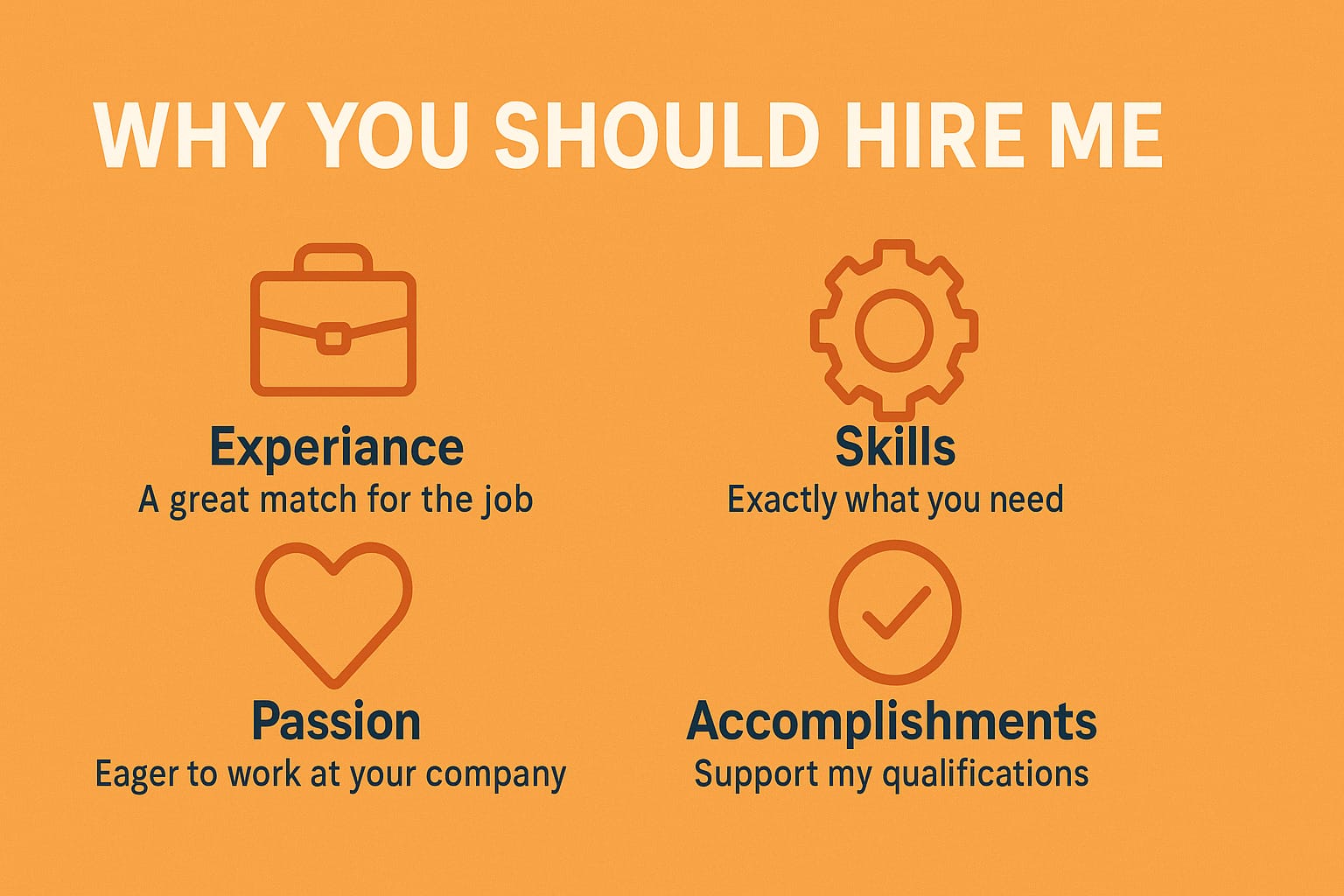
- Your experience is an excellent match for the job description
- Your skill set is precisely what they need
- You’ve always wanted to work at (name of company)
- Your accomplishments support your experience.
You need to remember to be fully prepared for the interview. While this is a difficult question to answer, the interview will have others as well.
Understanding What Employers Really Want
When interviewers ask why they should hire you, they are not looking for a slogan; they are testing whether you understand their business needs and can clearly connect your experience to those needs. Instead of reciting
Learn Exactly How To Correctly Prepare For An Interview & Give Yourself The Best Possible Chance Of Getting Hired In The Modern Job Market

Preparing Evidence That Proves Your Value
To give a persuasive answer, you need specific, memorable examples that show your impact rather than vague claims about being hard-working or passionate. Start by reviewing your recent roles and identifying moments when you saved time, improved quality, increased revenue, or strengthened relationships. Turn those moments into short, quantified success stories that tie directly to skills mentioned in the job description or core competencies highlighted on the company’s careers page.
Structuring a Confident, Memorable Hiring Pitch
A strong response to why you should be hired follows a clear structure that moves from your understanding of the role through proof of your strengths to the business results you can help create. Before the interview, outline your answer so it feels natural, flexible, and tailored rather than memorized. Use a simple framework that you can adapt to different employers, seniority levels, and industries while still sounding authentic and conversational in the room.
- Opening Focus: Start by briefly summarizing what you understand the role to be responsible for and the main challenge the team is trying to solve.
- Relevant Strengths: Highlight two or three strengths that clearly match those responsibilities, using language similar to the job description but not copying it word for word.
- Proof Points: Share one or two concise success stories with measurable outcomes that demonstrate you have already delivered similar results in previous roles.
Aligning Delivery, Body Language, and Follow-Up
Even a perfectly worded answer can fall flat if your delivery suggests uncertainty, defensiveness, or disinterest. Aim for a calm, open posture, steady but not unbroken eye contact, and a tone that sounds conversational rather than rehearsed. After answering, pause and invite follow-up questions to make the conversation feel collaborative. Later, reinforce your message with a concise thank-you

Further Guidance & Tools
- Interview Question Guide: Review detailed examples of how to answer “Why should we hire you?” on Indeed to refine your own response.
- Answer Strategies: Explore practical frameworks and sample answers for tough
interview questions to shape a stronger pitch. - Competency Focus: Use Indeed guidance to practice behavioral interview responses that highlight your accomplishments and core competencies.
- STAR Method: Learn how to structure your examples using the STAR framework with practical advice from Harvard Business Review so your stories are clear and compelling.
- Role Research: Use occupation profiles on O*NET OnLine to align your strengths with the requirements and tasks of your target roles.
Next Steps
- Identify three recent professional achievements and rewrite them as concise impact statements that clearly show measurable results relevant to your target roles.
- Draft a short answer script on why we should hire you and revise it until it clearly connects your strengths to the employer’s top priorities.
- Practice delivering your answer aloud, focusing on natural pacing, confident tone, and open body language that reinforces the message you are communicating.
- Review a recent job description and highlight phrases you can echo in your answer so your pitch mirrors the employer’s language and expectations.
- Ask a trusted friend or mentor to role-play the interviewer and provide feedback on clarity, confidence, and relevance in your response.
In today's job market, how you perform in an interview can make or break your hiring possibilities. If you want to stand ahead. above the rest of the pack, 301 Smart Answers to Tough Interview Questions is the definitive guide you need
Final Words
Answering why you should be hired is less about memorizing the perfect line and more about clearly connecting your strengths to the employer’s needs. When you understand the role, prepare real examples, and communicate with confidence, you turn a dreaded question into a powerful opportunity to stand out.
Some Must-Read Books:
What Color Is Your Parachute? by Richard N. Bolles is a classic job-search book that offers valuable advice on interviewing techniques, among other topics. This book is updated annually and covers all aspects of the
More than a job-hunting book, Richard N. Bolles’s timeless wisdom and famed self-assessment exercise clarifies seven key dimensions, so you can uncover your greatest passions, most valued traits, and transferable skills to design a life that enables you to flourish.

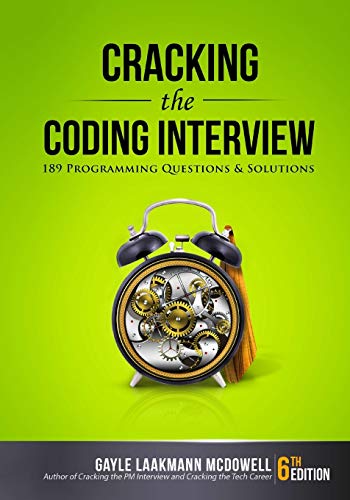
Cracking the Coding Interview by Gayle Laakmann. It is a good book to read if you are applying for a technical job. McDowell is the go-to book. This book is specifically designed to help programmers and software engineers prepare for coding interviews. It provides over 150 programming questions that are frequently asked in coding interviews, along with detailed solutions and explanations. The book also includes tips on how to approach coding interviews, what to expect, and how to ace them.
Cracking the Coding Interview, 6th Edition is here to help you through this process, teaching you what you need to know and enabling you to perform at your very best.
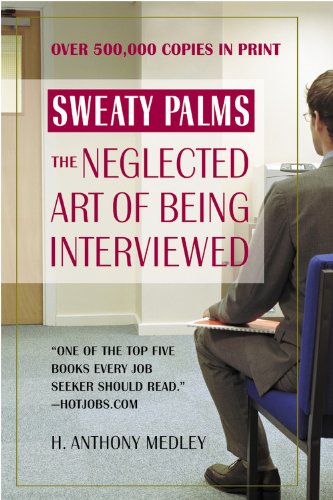
Sweaty Palms by H. Anthony Medley is a comprehensive book that guides all aspects of the interview process. It covers topics such as preparing for an interview, what to wear, how to answer common
A newly updated edition of the comprehensive guide to job interviews that has over a half million copies in print, SWEATY PALMS teaches readers everything they need to know in order to land the job of their dreams.
Whether a first-time job seeker searching for that elusive entry-level position or a seasoned e
Interview Like a Boss by Hans Van Nas is a comprehensive book that covers all aspects of the interview process, from preparation to follow-up. It includes advice on creating a strong resume and
Your resume will kick-@ss, your answers will rock and your job offers will be exciting as hell. Whether you dropped out or graduated, you will soon master all aspects of interviewing & job hunting.


Mark Fiebert is a former finance executive who hired and managed dozens of professionals during his 30-plus-year career. He now shares expert job search, resume, and career advice on CareerAlley.com.