- Key Takeaways
- Why Data Science Still Attracts Students
- Career Opportunities Remain Promising
- What Employers Expect From New Candidates
- Data Science Includes Many Career Paths
- Technology Is Only Part of the Appeal
- How to Evaluate a Data Science Program
- Projects Build Credibility Before Graduation
- A Practical Career, Not a Trendy Label
- Further Guidance & Tools
- Next Steps
- Final Words
- Additional Resources
We may earn a commission if you click on a product link and make a purchase at no additional cost to you. For more information, please see our disclosure policy.
Last updated: July 10, 2026

Key Takeaways
- Strong Outlook: Data science continues to offer attractive career opportunities, but completing a course or degree does not guarantee an easy path into the field.
- Broader Skills: Employers want candidates who combine statistics, programming, database knowledge, communication, business judgment, and responsible use of AI tools.
- Multiple Paths: Data science education can lead to roles in analytics, business intelligence, machine learning, data engineering, research, and specialized industry work.
- Program Quality: The strongest courses include current tools, realistic datasets, substantial projects, instructor support, and clear evidence of graduate career outcomes.
- Proof Matters: Portfolios, internships, capstone projects, and well-explained analyses often provide stronger evidence of job readiness than coursework alone.
Why Data Science Still Attracts Students
Data science continues to attract students because it combines technology, statistics, business strategy, and problem-solving. Organizations across finance, healthcare, retail, manufacturing, government, transportation, and research need professionals who can turn large or complicated datasets into useful information. The work may involve forecasting demand, detecting fraud, improving operations, evaluating customer behavior, testing products, or assessing the performance of artificial intelligence systems.
Students also have more ways to enter the field than they did when data science first became a widely promoted
Learn Data Wrangling, Exploration, Visualization, and Modeling with Python
Learning Data Science is the first book to cover foundational skills in both programming and statistics that span the entire data science lifecycle.


Career Opportunities Remain Promising
The employment outlook is one reason students continue pursuing data science. The Bureau of Labor Statistics data scientist wage profile shows that the occupation offers strong earning potential, although compensation varies considerably by experience, location, industry, education, and technical specialization. Federal projections also indicate that employment for data scientists should grow much faster than the average for all occupations.
Those numbers represent opportunity, not a guarantee. Entry-level candidates may compete with applicants who have graduate degrees, internships, industry experience, or extensive project portfolios. Students should avoid assuming that finishing a program will automatically lead to a high-paying offer. The guide to finding the right data science job can help candidates focus on positions that match their skills rather than applying indiscriminately.
What Employers Expect From New Candidates
Employers generally need more than someone who can run a machine learning model or copy code from a tutorial. Data professionals must understand the question being asked, judge whether the available data is suitable, select an appropriate method, test the result, and explain the findings to people who may not have a technical background.
- Programming: Python or R for analysis, modeling, automation, and reproducible workflows.
- Databases: SQL and data-management skills for finding, joining, cleaning, and organizing information.
- Statistics: Probability, sampling, regression, experimentation, inference, and model evaluation.
- Machine Learning: Model selection, validation, feature development, interpretation, and responsible deployment.
- Communication: Clear visualizations, concise writing,
presentations , and recommendations connected to business needs. - AI Judgment: The ability to use AI-assisted tools while verifying code, assumptions, calculations, and conclusions.
Build the tech career that's right for you.
Explore thousands of top tech employers hiring on Dice

Online education can help students strengthen individual skills. Platforms such as Udemy courses and professional training offer flexible options, but taking unrelated courses without a clear plan can leave important gaps. Students should identify a target role first and then build the required skills in a logical sequence.
Data Science Includes Many Career Paths
Studying data science does not limit someone to the title of data scientist. Related career paths include data analyst, business intelligence analyst, machine learning engineer, data engineer, product analyst, marketing analyst, quantitative analyst, research analyst, and analytics consultant. Some positions focus heavily on programming and infrastructure, while others emphasize statistics, dashboards, experimentation, or business decision-making.
Job titles are not always consistent across employers. A data analyst at one company may perform work similar to a data scientist at another. Students should study actual job descriptions rather than choosing a path based solely on a title. The overview of data science roles and responsibilities explains how common positions differ and what employers may expect from each one.
Statistical methods are a key part of data science, yet few data scientists have formal statistical training. Courses and books on basic statistics rarely cover the topic from a data science perspective. The second edition of this popular guide adds comprehensive examples in Python, provides practical guidance on applying statistical methods to data science, tells you how to avoid their misuse, and gives you advice on what’s important and what’s not.

Technology Is Only Part of the Appeal
Data science gives students opportunities to work with machine learning, cloud platforms, visualization software, large databases, automation, and generative AI. However, the most valuable work is not always based on the newest or most complicated technology. A simple analysis that solves an important problem can create more value than an advanced model that nobody understands or trusts.
Employers increasingly expect data professionals to understand the limits of automated tools. AI can generate code, suggest methods, summarize information, and speed up documentation, but it can also introduce errors, invent explanations, or conceal weak assumptions. Students who can evaluate AI-generated work, protect sensitive information, and explain their reasoning will be more useful than those who rely on tools they do not understand.
How to Evaluate a Data Science Program
A program’s name does not prove that it provides useful preparation. Students should examine the curriculum, instructors, project requirements, technologies, career services, and published outcomes before committing significant time or money. A strong program should connect technical lessons to realistic analytical problems and require students to explain their conclusions.
- Check prerequisites: Determine whether the program expects previous coursework in calculus, statistics, programming, or linear algebra.
- Review projects: Look for capstones, internships, employer-sponsored assignments, or substantial analyses using realistic datasets.
- Inspect tools: Confirm that students use current programming languages, databases, visualization platforms, and collaborative workflows.
- Evaluate support: Compare instructor access, tutoring, career guidance, alumni networks, and assistance finding internships.
- Verify outcomes: Ask how employment rates, salary figures, and graduate success claims were calculated.
- Compare costs: Consider tuition, financing, lost work time, and realistic career benefits before enrolling.
The guide to deciding whether a course fits your goals provides additional questions to consider before paying for professional education.
Ready to reimagine your career?
Get the skills and real-world experience employers want with Career Accelerators.

Projects Build Credibility Before Graduation
Coursework alone gives employers limited evidence of how a candidate approaches a real problem. Students should complete projects that demonstrate how they gathered or cleaned data, selected a method, checked assumptions, evaluated results, and translated the analysis into a useful recommendation. A clear, well-documented project is often more persuasive than an unnecessarily complicated model.
Public datasets can support projects involving transportation, housing, public health, finance, environmental issues, or customer behavior. Students should document limitations and explain what their analysis can and cannot prove. Developing a stronger foundation through these statistics books for data science can improve both the quality of the work and the ability to discuss it during interviews.
A Practical Career, Not a Trendy Label
Data scientists can contribute to important work involving healthcare, climate, fraud prevention, public policy, education, logistics, and resource planning. That creates meaningful opportunities, but it also places responsibility on practitioners to recognize biased data, weak models, privacy concerns, and uncertainty.
Data science is best understood as a practical profession, not a fashionable job title. The O*NET data scientist profile shows that the work involves transforming raw data into useful information, applying analytical methods, and communicating findings. Long-term success depends on disciplined analysis, curiosity, collaboration, clear communication, and the ability to solve genuine problems.
Further Guidance & Tools
- Career Outlook: The BLS data scientist outlook provides current information on duties, education, pay, and projected employment.
- Job Requirements: The O*NET data scientist profile outlines common tasks, technologies, knowledge areas, and workplace expectations.
- Public Datasets: Data.gov provides government datasets that students can use for practical portfolio projects.
- Project Practice: Kaggle datasets offer material for practicing analysis, visualization, modeling, and documentation.
- Program Example: The WPI online data science curriculum illustrates how graduate study can combine analytics, databases, machine learning, and project work.
We’re with you until you land your next job — placement support guaranteed. Four expert services. One simple fee. This personal, done-for-you, job placement support service has everything you need to find your next role.

Next Steps
- Choose a Role: Compare analytics, data science, engineering, business intelligence, and machine learning jobs before selecting an education path.
- Audit Skills: Identify gaps in programming, SQL, statistics, visualization, communication, and business knowledge before purchasing additional training.
- Compare Programs: Review curricula, projects, instructor access, total cost, career services, and published outcomes side by side.
- Build Proof: Complete two or three projects that demonstrate analytical reasoning, technical execution, validation, and clear communication.
- Test Interest: Finish an introductory course and small project before committing to an expensive degree or intensive boot camp.
Final Words
Data science remains a promising field for students who enjoy analytical work and are prepared to develop a broad combination of technical and professional skills. The strongest preparation includes statistics, programming, databases, machine learning, communication, ethical judgment, and substantial project experience. Choose education based on the capabilities and evidence it helps you build, not simply the program’s title, marketing language, or promises of rapid employment.
Additional Resources
-

$25.00$23.77Learn MoreThe OpenIntro project was founded in 2009 to improve the quality and availability of education by producing exceptional books and teaching tools that are free to use and easy to modify. Our inaugural effort is OpenIntro Statistics. Probability is optional, inference is key, and we feature real data whenever possible.
We earn a commission if you click this link and make a purchase at no additional cost to you.
10/14/2026 10:29 pm GMT -
 $54.99Learn More
This book provides an undergraduate introduction to analysing data for data science, computer science, and quantitative social science students. It uniquely combines a hands-on approach to data analysis – supported by numerous real data examples and reusable [R] code – with a rigorous treatment of probability and statistical principles.
We earn a commission if you click this link and make a purchase at no additional cost to you.
10/14/2026 10:28 pm GMT -

$89.99$76.99Learn MoreProbability and Statistics for Data Science: Math + R + Data covers "math stat"―distributions, expected value, estimation etc.―but takes the phrase "Data Science" in the title quite seriously
We earn a commission if you click this link and make a purchase at no additional cost to you.
10/14/2026 10:28 pm GMT -

$94.00$44.99Learn MoreMachine learning methods extract value from vast data sets quickly and with modest resources. They are established tools in a wide range of industrial applications, including search engines, DNA sequencing, stock market analysis, and robot locomotion, and their use is spreading rapidly.
We earn a commission if you click this link and make a purchase at no additional cost to you.
10/14/2026 10:28 pm GMT -
$79.99$70.00Learn MoreStatistical methods are a key part of data science, yet few data scientists have formal statistical training. Courses and books on basic statistics rarely cover the topic from a data science perspective. The second edition of this popular guide adds comprehensive examples in Python, provides practical guidance on applying statistical methods to data science, tells you how to avoid their misuse, and gives you advice on what’s important and what’s not.
We earn a commission if you click this link and make a purchase at no additional cost to you.
10/14/2026 10:28 pm GMT -
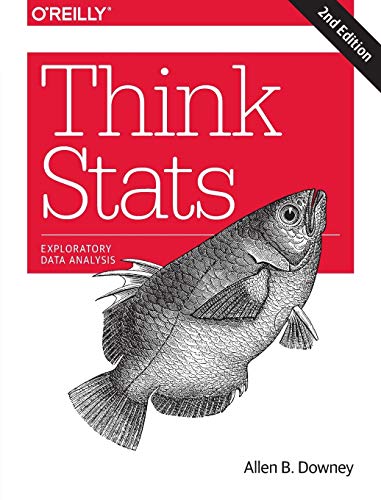 $38.57Learn More
If you know how to program, you have the skills to turn data into knowledge, using tools of probability and statistics. This concise introduction shows you how to perform statistical analysis computationally, rather than mathematically, with programs written in Python.
We earn a commission if you click this link and make a purchase at no additional cost to you.
10/15/2026 01:36 pm GMT -

$89.99$66.66Learn MoreA concept-focused introduction to statistical learning and data mining across fields such as medicine, finance, biology, and marketing. It covers supervised and unsupervised learning, including neural networks, support vector machines, decision trees, boosting, random forests, ensemble methods, lasso, graphical models, and techniques for high-dimensional data.
We earn a commission if you click this link and make a purchase at no additional cost to you.
10/14/2026 09:29 pm GMT

Mark Fiebert is a former finance executive who hired and managed dozens of professionals during his 30-plus-year career. He now shares expert job search, resume, and career advice on CareerAlley.com.