- Key Takeaways
- Know Your Market Value
- Cross-Check Salary Data
- Build a Defensible Range
- Prepare Your Value Case
- Negotiate a New Job Offer
- Ask for a Raise
- Avoid Negotiation Mistakes
- Negotiate the Entire Package
- Respond to Pushback
- Evaluate the Opportunity
- Related CareerAlley Guides
- Further Guidance & Tools
- Next Steps
- Final Words
We may earn a commission if you click on a product link and make a purchase at no additional cost to you. For more information, please see our disclosure policy.
Last updated: August 25, 2026

Key Takeaways
- Research market value: Compare occupation, location, industry, experience, skills, and scope across several reputable sources before deciding whether your compensation is competitive.
- Build evidence: Support your target with quantified achievements, expanded responsibilities, scarce skills, and examples that connect your work to business results.
- Set boundaries: Define a researched target, an acceptable range, and a private minimum before discussing compensation with an employer.
- Consider total rewards: Evaluate salary alongside bonuses, benefits, retirement contributions, flexibility, paid leave, development support, and advancement potential.
- Stay collaborative: Ask clear questions, listen for constraints, propose alternatives, document commitments, and know when another opportunity offers better value.
Are you underpaid? The answer is not based on instinct, a colleague’s salary, or the size of your last raise. Your market value reflects what employers currently pay for comparable work, adjusted for your location, industry, experience, specialized skills, responsibilities, and results. Learning that value gives you a credible foundation for evaluating an offer, requesting a raise, or deciding whether to pursue a different role.
A new job often creates the clearest opportunity to reset your compensation, but it is not the only one. A promotion, major increase in responsibilities, strong performance cycle, or hard-to-replace expertise can also create leverage. The goal is to replace “I feel underpaid” with a specific, evidence-backed case for what the role and your contribution are worth. CareerAlley’s boost your earnings resource can help you prepare for that conversation.
Our job offer and salary negotiation courses will teach you how to negotiate with confidence and secure competitive compensation. Based on hundreds of successful salary negotiations, our courses will help you negotiate a better job offer or more at your current company.
Enroll and start negotiating your way to success!


Know Your Market Value
Start by matching the work, not merely the title. Two people called project manager may oversee different budgets, teams, risks, and strategic decisions. Compare job descriptions with your actual responsibilities, then note the qualifications, technical skills, leadership duties, certifications, and measurable outcomes that distinguish you from a typical candidate.
Current government wage data can show how pay varies by occupation, geography, and industry. The Bureau of Labor Statistics publishes wage distributions rather than one universal “correct” salary, which is useful because your target should be a defensible range. Research industry salary standards and compare several sources, since each tool uses different data and methods.
Consider how recently the information was updated, whether it reflects base salary or total compensation, and how closely its comparison group matches your situation. Salary estimates become more useful when you filter by city or region, company size, industry, experience level, and role scope. If you are changing careers, separate transferable value from experience you have not yet gained in the new field.
Cross-Check Salary Data
No single calculator should determine your target. Use several resources, discard obvious outliers, and look for a range supported by multiple sources. These tools offer different views of the market:
- Professional guides: The Robert Half Salary Guide provides starting-pay benchmarks in several professional fields. The same source’s 2024 Salary Guide link remains a useful entry point to its current guide and calculator.
- Broad comparisons: Salary.com, Indeed.com – Salary Search, and the Glassdoor Salary Calculator let you compare roles and locations.
- Additional estimates: Salary.com, Glassdoor Salary Calculator, PayScale, and Indeed.com – Salary Search provide useful cross-checks when their comparison groups resemble your role.
- Specialized searches: JobStar Salary Surveys collects field-specific survey links, while ZipRecruiter offers another view of reported salary ranges.
Keep a simple research sheet listing each source, the date checked, the role and location used, and the reported range. Relevant search tools can help organize a broader
We’re with you until you land your next job — placement support guaranteed. Four expert services. One simple fee. This personal, done-for-you, job placement support service has everything you need to find your next role.

Build a Defensible Range
Turn your research into three figures: a target you can justify, an acceptable range, and a private walk-away point. Your target should reflect the role’s scope and your strongest evidence. The acceptable range gives both sides room to negotiate. Your minimum should account for the entire package and your alternatives, but you don’t need to disclose it.
Your current salary is not proof of your future value. If asked for expectations, redirect to the responsibilities and the employer’s approved range when possible. Once you understand the role, offer a researched range and explain the factors behind it. Remember that how much compensation you are offered matters, but so do growth, stability, fit, and the value of benefits.
Easily get higher salary outcomes by using the book’s scripted email and phone templates for over 60 negotiation scenarios. Unlike other negotiation books, you will never be left guessing how to apply a negotiation theory or principle.

Prepare Your Value Case
A credible request connects your work to outcomes the employer values. Select three to five examples showing revenue gained, costs reduced, risks avoided, time saved, quality improved, customers retained, or responsibilities expanded. Share specific examples where you exceeded expectations, and explain both the result and the part you personally delivered.
Create a one-page summary with the target range, strongest accomplishments, relevant market benchmarks, and your preferred package. You can draft it in Google Docs so the evidence is easy to revise and share. Practice stating your request in one or two sentences, then rehearse likely questions, objections, and counteroffers with someone who will challenge your reasoning.
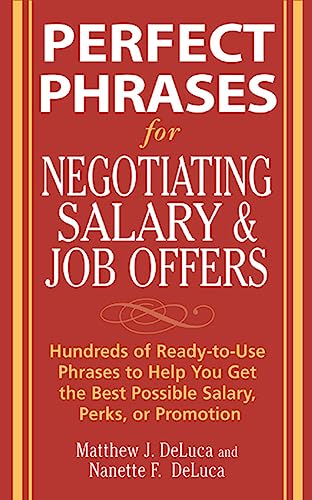
The latest guide in the top-selling, easy-to-use Perfect Phrases series gives you the correct vocabulary to use to get the best salary or job offer possible. Using words and phrases that take away the taboo surrounding the subject of money, you can ask for what you want-and deserve-with confidence.
Negotiate a New Job Offer
Wait until you have enough information to evaluate the role and, ideally, a written offer. Express enthusiasm, ask for time to review the details, and clarify anything ambiguous before countering. Then make a concise request tied to market evidence, responsibilities, and the value you bring. A calm pause after the request gives the employer room to respond.
Books such as Job Offer Negotiation Skills, Negotiating Your Salary: How To Make $1000 a Minute, and How to Negotiate A Killer Job Offer provide scripts and practice ideas. Courses such as enrolling in negotiation programs can also deepen broader negotiation skills.
This book makes it easier than ever to earn thousands of extra dollars because it adds many key concepts to the "bible" of salary negotiations.

Ask for a Raise
For an internal raise, choose timing that makes your contribution visible. A performance review, a completed high-impact project, a promotion discussion, or a planning period may create a natural opening. Request a dedicated meeting rather than raising compensation unexpectedly. CareerAlley’s guide on when Now, it’s time to ask for a raise can help frame the discussion.
Focus on business value and expanded scope, not personal expenses or the belief that you have waited long enough. State the adjustment you are seeking, summarize the evidence, and ask what the decision process and timing look like. If approval isn’t possible, request specific performance criteria, a written review date, and clarity on who must authorize the change.
This book is filled with foolproof techniques for acquiring the knowledge and skills for increasing your share of life’s riches.

Avoid Negotiation Mistakes
- Do not improvise: Entering without market evidence, a target, and prepared examples makes it easier to accept an inadequate offer.
- Do not get personal: Employers respond more readily to business results, role scope, and market benchmarks than private financial needs.
- Do not become confrontational: Ultimatums and frustration narrow options; direct, respectful language preserves leverage and professional relationships.
- Do not overtalk: Make the case clearly, ask a focused question, and listen for budget, timing, policy, or approval constraints.
- Do not bluff: Mention another offer or willingness to leave only when it is true and you are prepared to act.
Easily get higher salary outcomes by using the book’s scripted email and phone templates for over 60 negotiation scenarios. Unlike other negotiation books, you will never be left guessing how to apply a negotiation theory or principle.
Negotiate the Entire Package
Base salary is only one component of an offer. Compare medical and dental coverage, retirement contributions, bonuses, equity or profit-sharing, paid leave, severance terms, professional development, title, advancement potential, commute expectations, and schedule flexibility. Review eligibility dates, vesting rules, performance conditions, and employee costs before assigning value to any benefit.
If salary is constrained, prioritize alternatives that matter to you: a signing bonus, a guaranteed first-year bonus, additional vacation, an earlier compensation review, a training budget, an improved title, remote days, or a flexible schedule. A work-from-home arrangement may have meaningful practical value, but confirm expectations in writing rather than relying on a verbal understanding.
Calculate the package’s likely annual value and note what is guaranteed, variable, or deferred. For help managing cash flow after accepting an offer, CareerAlley’s salary resource covers the transition from earnings to financial planning.
This book makes it easier than ever to earn thousands of extra dollars because it adds many key concepts to the "bible" of salary negotiations.
Respond to Pushback
Treat “no” as the beginning of diagnosis, not an invitation to argue. Ask whether the constraint is the salary band, current budget, timing, experience level, internal equity, or approval process. The answer determines whether to adjust the package, supply more evidence, propose a phased increase, or decide the gap is unlikely to close.
- Clarify the gap: Ask what separates the offer from your requested range and what evidence could change the decision.
- Trade strategically: Offer flexibility on lower-priority terms in exchange for movement on the items that create the greatest value.
- Set a checkpoint: If money is unavailable now, agree on measurable goals, decision ownership, and a specific review date.
- Protect options: Continue evaluating alternatives until every important term is confirmed and you are ready to accept.
Send a concise recap after the conversation, including decisions, open questions, owners, and dates. Continue documenting results so a future review starts with stronger evidence. If commitments repeatedly slip or the employer treats reasonable questions dismissively, another role may offer a better match for your contribution and goals.
Our job offer and salary negotiation courses will teach you how to negotiate with confidence and secure competitive compensation. Based on hundreds of successful salary negotiations, our courses will help you negotiate a better job offer or more at your current company.
Enroll and start negotiating your way to success!
Evaluate the Opportunity
A higher salary cannot compensate for every problem. Consider the manager, culture, workload, business outlook, advancement path, learning opportunities, and whether the position moves you toward your long-term goals. During each job interview, ask how success is measured, why the role is open, how promotions work, and what has helped previous employees thrive.
Strong questions during an interview help reveal whether the opportunity supports the compensation, stability, and growth you want. When comparing offers, score the same factors consistently so an exciting title or signing bonus does not obscure a weak long-term fit.
Related CareerAlley Guides
- Salary Negotiation – Tips and Advice: Review practical preparation and job-offer negotiation principles.
- “How Much Should I be Paid”: Examine the factors that shape an appropriate salary target.
- “Decoding Salary Talk: 5 Essential Interview Tips”: Prepare for compensation questions during interviews.
- “Ask for a Raise in 3 Easy Steps: Your Roadmap to More Money”: Structure an internal salary request.
- “5 Reasons Why You Won’t Get A Raise”: Identify behaviors that weaken a raise case.
- “Boost Your Salary: Tips for Nailing a Raise Request”: Improve timing and delivery.
- “Unlock Extra Income: A Guide to Earning More”: Consider income options beyond a salary adjustment.
This book makes it easier than ever to earn thousands of extra dollars because it adds many key concepts to the "bible" of salary negotiations.
Further Guidance & Tools
- OEWS Wage Data: Compare occupational wages by location, industry, and percentile using current federal estimates.
- Salary Finder: Search local salary ranges for hundreds of occupations through this U.S. Department of Labor-sponsored tool.
- Negotiation Workbook: Build a negotiation plan with the Department of Labor’s preparation and offer-evaluation exercises.
Next Steps
- Define scope: Match your real responsibilities to comparable roles, then note location, industry, experience, and specialized skills that affect pay.
- Research range: Compare at least three current sources, record their assumptions, and choose a defensible target, acceptable range, and private minimum.
- Gather proof: Select three measurable achievements, connect each to business value, and prepare a concise one-page summary for the conversation.
- Practice request: Rehearse your opening, desired range, likely objections, and preferred alternatives until you can respond calmly without overexplaining.
- Confirm terms: Review total compensation, secure every negotiated commitment in writing, and record owners, milestones, and follow-up dates before accepting.
Final Words
Knowing what you are worth is not about finding the largest salary posted online. It is about building a realistic picture of the market, connecting that evidence to the value you deliver, and deciding which terms matter most to you. Prepare carefully, negotiate with clarity, and evaluate the entire opportunity rather than one number. A respectful conversation may improve the offer, create a documented path to a raise, or reveal that your best leverage is the confidence to pursue a better fit.






Mark Fiebert is a former finance executive who hired and managed dozens of professionals during his 30-plus-year career. He now shares expert job search, resume, and career advice on CareerAlley.com.