- Key Takeaways
- Understand What Makes Your Skills Valuable
- Track Industry Changes Before They Affect Your Role
- Think Like an Owner Without Taking on Everything
- Develop Skills That Solve Real Problems
- Build Specialized Expertise Without Becoming Trapped
- Use High-Impact Projects to Demonstrate Value
- Make Your Contributions Visible
- Make Learning a Repeatable Process
- Use AI to Improve Your Work, Not Replace Your Judgment
- Build Career Security Beyond Your Current Employer
- Maintain Visibility Without Burning Out
- Further Guidance & Tools
- Next Steps
- Final Words
We may earn a commission if you click on a product link and make a purchase at no additional cost to you. For more information, please see our disclosure policy.
Last updated: October 13, 2026
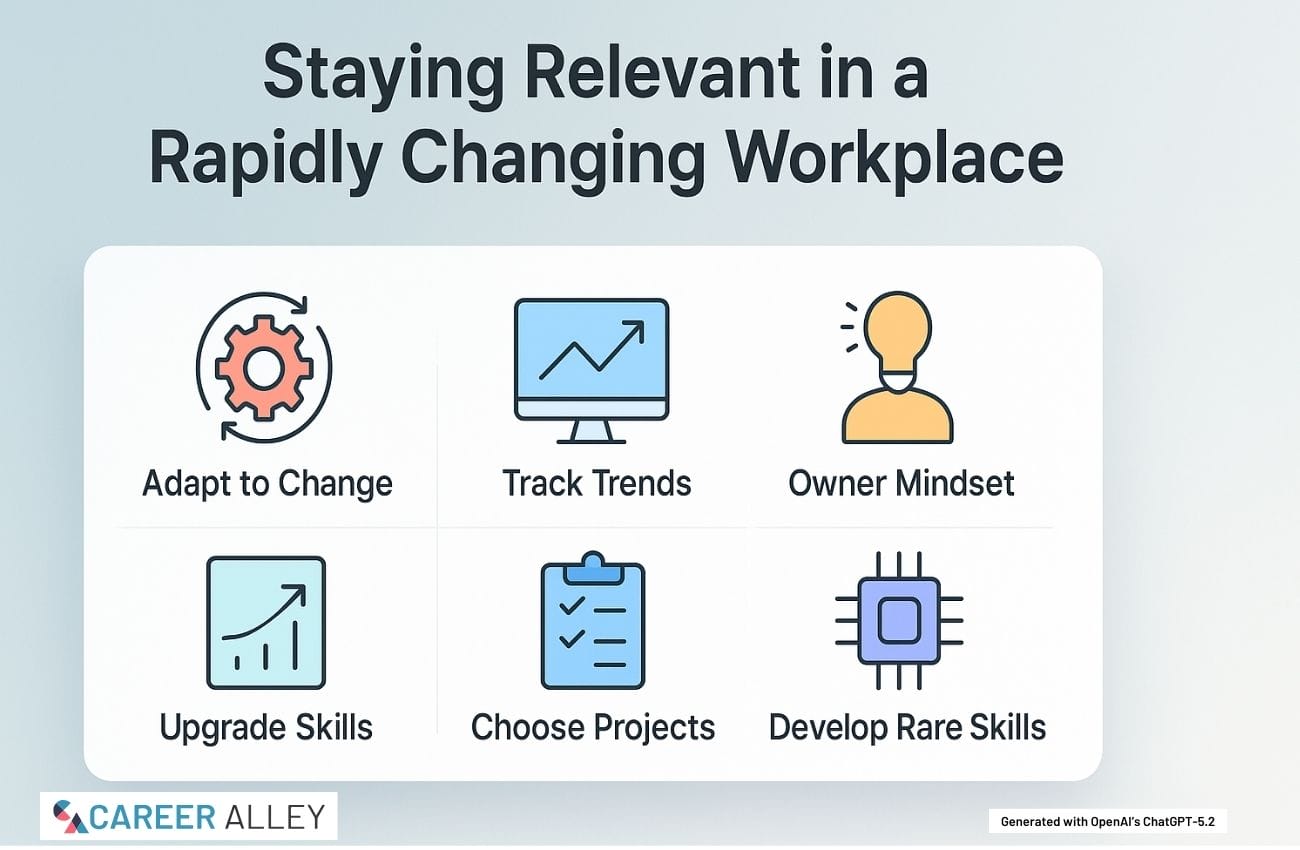
Key Takeaways
- Adaptability Builds Resilience: Job security improves when you anticipate changing expectations, learn relevant skills, and demonstrate that you can contribute as responsibilities evolve.
- Results Demonstrate Value: Employers need evidence of your contributions, so measurable improvements, dependable execution, and effective problem-solving matter more than simply staying busy.
- Strategic Learning Matters: Choose skills based on actual workplace needs, emerging responsibilities, and career opportunities rather than collecting credentials without a practical application.
- Ownership Creates Trust: Taking responsibility for outcomes, identifying improvements, and communicating proactively can strengthen your professional reputation without requiring constant overtime.
- Career Security Requires Options: Build transferable skills, maintain professional relationships, and document accomplishments so your career remains resilient even when organizational circumstances change.
Staying relevant at work requires more than performing your current responsibilities well. Employers change priorities, introduce new technology, reorganize teams, and adjust staffing based on business conditions. Skills that once made an employee indispensable may become less valuable when the work itself changes.
The strongest approach combines three habits: understanding what your organization needs, developing skills that address those needs, and demonstrating the results of your contributions. These habits can improve your standing with your current employer while preparing you for opportunities elsewhere.
However, no employee can guarantee job security through individual performance alone. Layoffs, mergers, budget reductions, and strategic changes can affect even outstanding professionals. The objective is to increase your value, adaptability, and career options rather than assume that loyalty or hard work will prevent every setback.
Job security today depends on adaptability, skill relevance, and thinking like an owner. This article shows how to stay valuable as work evolves and expectations rise. See how to protect your career. #JobSecurityClick To TweetUnderstand What Makes Your Skills Valuable
Your professional value comes from the problems you can solve, the responsibilities you can handle, and the results you help produce. Experience matters, but its value depends partly on how effectively you apply it to current business needs.
In its 2025 Future of Jobs Report, the World Economic Forum estimated that employers expect 39% of workers’ existing core skills to change by 2030. That projection reflects surveyed employer expectations, not a prediction that individual workers will lose 39% of their skills or that every occupation will experience the same disruption.
Technology is one influence. The PBS NewsHour discussion of how Careers are increasingly shaped by rapid change provides a useful starting point for considering how artificial intelligence affects work and career preparation.
For additional background on organizational applications, artificial intelligence is also a subject worth examining from a business perspective.
Technical knowledge is only part of the equation. Analytical thinking, communication, sound judgment, adaptability, and collaboration help employees translate information and technology into useful outcomes.
Consider two employees who perform similar administrative work. One continues producing reports using established procedures. The other learns to automate repetitive calculations, identifies recurring errors, and helps colleagues interpret the results. Both employees contribute, but the second creates additional value beyond completing assigned tasks.
The lesson is not that everyone must become a technology specialist. It is that understanding how your work creates value helps you identify which capabilities deserve your attention.
Track Industry Changes Before They Affect Your Role
Monitoring developments in your profession helps you distinguish between temporary trends and changes that could materially affect your responsibilities.
You do not need to follow every technology announcement or business prediction. Instead, focus on information that could influence hiring, required skills, industry regulations, customer expectations, or how work gets done.
- Follow Industry Sources: Read reputable trade publications, professional association updates, and relevant employer announcements.
- Review Job Postings: Examine current vacancies similar to your position to identify recurring skills, tools, and responsibilities.
- Watch Internal Changes: Pay attention to new software, organizational priorities, customer demands, and responsibilities shifting between departments.
- Use Professional Networks: Discuss emerging requirements with colleagues, recruiters, and experienced professionals in your field.
A monthly review is usually more useful than reacting to every headline. Look for patterns appearing across several credible sources, then determine whether those developments justify additional training or a change in priorities.
For example, a finance professional might discover that employers increasingly expect familiarity with automated reporting and data visualization. Rather than pursuing an unrelated technical qualification, that professional could concentrate on improving reporting workflows and interpreting financial information more effectively.
Think Like an Owner Without Taking on Everything
An ownership mindset means understanding the business consequences of your work and accepting responsibility for outcomes within your control.
It does not mean treating the company’s problems as your personal obligations, routinely working unpaid hours, or taking responsibility for decisions outside your authority.
Employees demonstrate ownership through practical behaviors:
- Understand Priorities: Connect your responsibilities to the organization’s financial, operational, customer service, or strategic objectives.
- Identify Problems: Recognize recurring errors, unnecessary costs, delays, and communication gaps before they become larger issues.
- Recommend Improvements: Present workable solutions with clear benefits rather than simply pointing out what is wrong.
- Follow Through: Complete commitments, communicate obstacles promptly, and ensure important responsibilities do not fall between teams.
- Exercise Judgment: Recognize when independent action is appropriate and when a decision requires management approval.
Suppose your department repeatedly experiences delays because information arrives in inconsistent formats. Developing a standardized submission template could reduce rework and improve turnaround times.
That contribution may be more valuable than volunteering for additional assignments that do not address an important business problem.
Knowing which actions support achieving success can also help you distinguish productive initiative from activity that creates little professional benefit.
Develop Skills That Solve Real Problems
Effective professional development begins with identifying a specific capability gap, not selecting a course because its title sounds impressive.
Start by examining your current responsibilities and identifying tasks that are becoming more difficult, time-consuming, or important. Then compare those needs with the skills employers expect in similar positions.
One useful approach is to separate potential learning opportunities into three categories:
- Essential Skills: Capabilities required to perform your current responsibilities competently and consistently.
- Emerging Skills: Knowledge and abilities becoming more important as technology, regulations, or organizational priorities evolve.
- Transferable Skills: Capabilities such as analytical thinking,
project management , communication, and leadership that remain useful across employers and industries.
Prioritize essential gaps that threaten current performance, followed by emerging skills likely to affect your role. Transferable skills deserve continuing attention because they support both internal advancement and external career mobility.
Developing in-demand, clearly demonstrable skills through targeted courses can be useful when the learning directly supports a specific professional objective.
For structured learning, Coursera provides another option for exploring courses and professional credentials.
Compare programs by curriculum, practical exercises, instructor qualifications, cost, and relevance to employer expectations. A certificate can demonstrate structured learning, but it does not automatically establish professional competence or satisfy a licensing requirement.
In regulated occupations, distinguish optional professional development from legally required training. For example, professionals working in California residential care facilities may need training associated with Residential Care Facility for the Elderly (RCFE) certification or renewal requirements. Verify those requirements directly with the appropriate California licensing authority.
The strongest learning investments produce capabilities you can apply, demonstrate, and continue developing.
Build Specialized Expertise Without Becoming Trapped
Specialized knowledge can increase your professional value when it addresses an important business need that other employees cannot easily meet.
However, becoming the only person who understands an outdated system or undocumented process does not necessarily create lasting career security. That situation may make you temporarily difficult to replace while limiting your opportunities elsewhere.
The better strategy is to develop expertise that combines organizational relevance with broader market value.
For example, a professional who understands financial reporting and develops advanced data analysis capabilities may offer more lasting value than someone whose expertise is limited to operating one employer’s proprietary reporting process.
Technical professionals can explore specialized skills through focused education, but the right specialization depends on existing experience, career goals, and employer demand.
TalentNeuron’s discussion of future workforce capabilities offers additional context for evaluating a sought-after skill.
Before committing substantial time or money to a specialization, ask whether it meets three conditions:
- Business Relevance: Does the skill solve an important problem or support a meaningful organizational objective?
- Market Demand: Do other employers seek this capability, or is it valuable only within your current organization?
- Practical Accessibility: Can you realistically develop and demonstrate the skill with your available resources and experience?
Skills that satisfy all three conditions generally offer stronger career-development potential than narrow expertise with little external application.
Use High-Impact Projects to Demonstrate Value
Strategic project participation lets you apply developing skills, build relationships, and demonstrate capabilities beyond your routine responsibilities.
The most useful assignments involve meaningful organizational challenges and provide a realistic opportunity to produce visible results.
Look for projects that improve operations, reduce costs, support customers, introduce useful technology, or strengthen cooperation between departments.
Cross-functional assignments can be particularly valuable because they expose you to business priorities outside your immediate role. They also help colleagues understand your capabilities and expand your internal professional network.
An important distinction exists between volunteering for responsibility and accepting unlimited additional work. A worthwhile assignment should offer meaningful experience, reasonable expectations, and an achievable outcome.
Before accepting a substantial project, clarify its objectives, expected time commitment, decision-making authority, and relationship to your existing workload.
Participation outside your regular workplace can also build valuable capabilities. Depending on the opportunity, Volunteering for meaningful work may provide experience in leadership, collaboration, communication, and problem-solving.
The deciding factor is not whether an assignment is technically voluntary. It is whether the experience develops relevant capabilities and produces results you can explain to future employers.
Make Your Contributions Visible
Strong performance does not always receive the recognition it deserves. Managers may oversee numerous responsibilities, work remotely from their teams, or lack direct visibility into individual accomplishments.
Professionals who communicate results clearly make it easier for decision-makers to understand their contributions.
This does not require excessive self-promotion. It requires keeping reliable records and sharing meaningful information at the right times.
Consider documenting:
- Efficiency Improvements: Time saved, unnecessary steps eliminated, or recurring errors reduced.
- Financial Contributions: Costs avoided, revenue supported, or resources used more effectively.
- Project Results: Deliverables completed, deadlines achieved, and obstacles successfully resolved.
- Collaboration: Improvements in coordination, knowledge sharing, or support provided to colleagues.
- Professional Growth: New capabilities developed and successfully applied to business responsibilities.
Use meaningful measurements when they are available and verifiable. If exact figures cannot be established, describe the improvement accurately without inventing percentages or financial benefits.
For example, explaining that you redesigned a reporting process to eliminate duplicate data entry communicates a specific contribution. Claiming a major productivity improvement without supporting evidence can weaken your credibility.
Consistent communication also strengthens career resilience by helping colleagues and managers recognize your judgment, dependability, and professional development.
Keep a private record of accomplishments that does not contain confidential company information. Review it before performance discussions, promotion conversations, and future job applications.
Make Learning a Repeatable Process
Professional development becomes more effective when you treat it as a recurring process rather than an occasional response to changing job requirements.
A practical approach is to work through one meaningful skill-development objective each quarter.
- Identify: Select a specific skill gap that affects current performance or an important future responsibility.
- Learn: Choose appropriate instruction, guided practice, mentoring, or independent study.
- Apply: Use the skill on a realistic assignment instead of relying entirely on exercises or theoretical understanding.
- Measure: Evaluate improvements in quality, efficiency, accuracy, or other relevant outcomes.
- Refine: Request feedback, address weaknesses, and determine whether additional development is justified.
For additional practical guidance, follow this Coursera guide to understand approaches to upskilling and professional development.
The process does not require an expensive qualification every quarter. Some of the most valuable improvements come from learning an advanced feature in existing software, improving a recurring procedure, or receiving targeted feedback from an experienced colleague.
For example, someone responsible for producing monthly management reports might learn to automate data preparation, implement the improvement, and compare the new process with the previous workflow.
That experience creates evidence of applied learning. It also provides a concrete accomplishment to discuss during a performance review or
Use AI to Improve Your Work, Not Replace Your Judgment
Artificial intelligence can help professionals complete selected tasks more efficiently, but understanding its limitations is essential to using it responsibly.
Potential applications include drafting routine communications, organizing information, brainstorming approaches, summarizing nonconfidential material, and assisting with appropriate data analysis or research.
The value depends on the task, the system being used, and the accuracy requirements.
AI-generated information can contain factual mistakes, omit important context, or produce convincing but incorrect explanations. Employees must remain responsible for reviewing outputs and ensuring that their work meets professional standards.
Before incorporating AI into your workflow:
- Check Policies: Confirm which tools and uses your employer permits.
- Protect Information: Avoid entering confidential, personal, financial, or proprietary information into systems without appropriate authorization and safeguards.
- Verify Results: Independently check important facts, calculations, references, and conclusions.
- Evaluate Benefits: Determine whether the technology genuinely improves quality or efficiency after
accounting for review and correction time.
Employees who combine sound professional judgment with appropriate technology use may be better positioned to improve workflows than those who either ignore useful tools or rely on them without adequate oversight.
AI proficiency should complement your expertise, not replace your understanding of the work you are responsible for delivering.
Build Career Security Beyond Your Current Employer
Becoming valuable to your organization is worthwhile, but relying entirely on one employer creates unnecessary career risk.
A strong career strategy includes keeping options open outside your current role, even when you are satisfied with your job.
Keep
Pay particular attention to transferable accomplishments. A project that demonstrates process improvement, effective leadership, or sound financial judgment may interest many employers, even when their systems and operating procedures differ.
Your professional network also deserves attention before you begin a
Internal advancement and external employability should reinforce one another. The ideal professional-development investment increases your contribution today while expanding the positions you could reasonably pursue tomorrow.
Maintain Visibility Without Burning Out
Career relevance should not depend on constant availability, excessive overtime, or accepting every request.
Overcommitment can reduce work quality, weaken decision-making, and leave insufficient time for the learning that supports long-term professional growth.
Instead, establish priorities with your manager and concentrate on contributions that meaningfully support organizational objectives.
When new responsibilities arise, discuss which existing commitments should change. If a project requires additional time or resources, raise those requirements before performance suffers.
Professionals can demonstrate reliability through consistent delivery, clear communication, and appropriate boundaries. These behaviors are often more sustainable than trying to prove your value by never declining additional work.
Periodically assess whether your responsibilities, learning opportunities, recognition, and workload remain reasonably aligned. If your organization offers limited development opportunities despite constructive discussions, that may signal it’s time to explore internal transfers or external positions.
Long-term career resilience involves protecting both your professional capabilities and your ability to maintain them.
Further Guidance & Tools
- Future Skills: Review the World Economic Forum’s 2025 skills outlook to understand employer expectations for changing technical, analytical, and interpersonal capabilities.
- Career Research: Explore the U.S. Bureau of Labor Statistics’ people and management skills research to see how adaptability, communication, and leadership relate to different occupations.
- Learning Strategies: Use Coursera’s upskilling guide to evaluate practical approaches to developing abilities that support your professional goals.
Next Steps
- Assess Skills: Compare your current capabilities with recent job postings and identify one important gap affecting your professional competitiveness.
- Identify Priorities: Discuss upcoming organizational needs with your manager and select a development objective that addresses a meaningful business challenge.
- Apply Learning: Complete targeted training and demonstrate the new capability through a practical assignment with a clearly defined outcome.
- Document Results: Record specific improvements, project contributions, and feedback that demonstrate your professional value without disclosing confidential employer information.
- Review Progress: Reassess your capabilities, accomplishments, professional network, and external career opportunities every quarter to identify necessary adjustments.
Final Words
Career security is strongest when your professional development serves two purposes: helping you contribute meaningfully to your current organization and preparing you to succeed if circumstances change. Concentrate on understanding business needs, applying useful skills, and building a record of accomplishments that reflects genuine results. Don’t confuse being indispensable to one process with being employable across an evolving profession. The more effectively you connect your experience to valuable, transferable capabilities, the better prepared you will be to pursue advancement, respond to unexpected changes, and make thoughtful decisions about your professional future.
Whether you're a seasoned professional in search of a career change or a beginner just entering the working world, you want to make the right choices from the beginning.



Mark Fiebert is a former finance executive who hired and managed dozens of professionals during his 30-plus-year career. He now shares expert job search, resume, and career advice on CareerAlley.com.