- Key Takeaways
- Is an MBA Still Worth It in 2026?
- What Is an MBA?
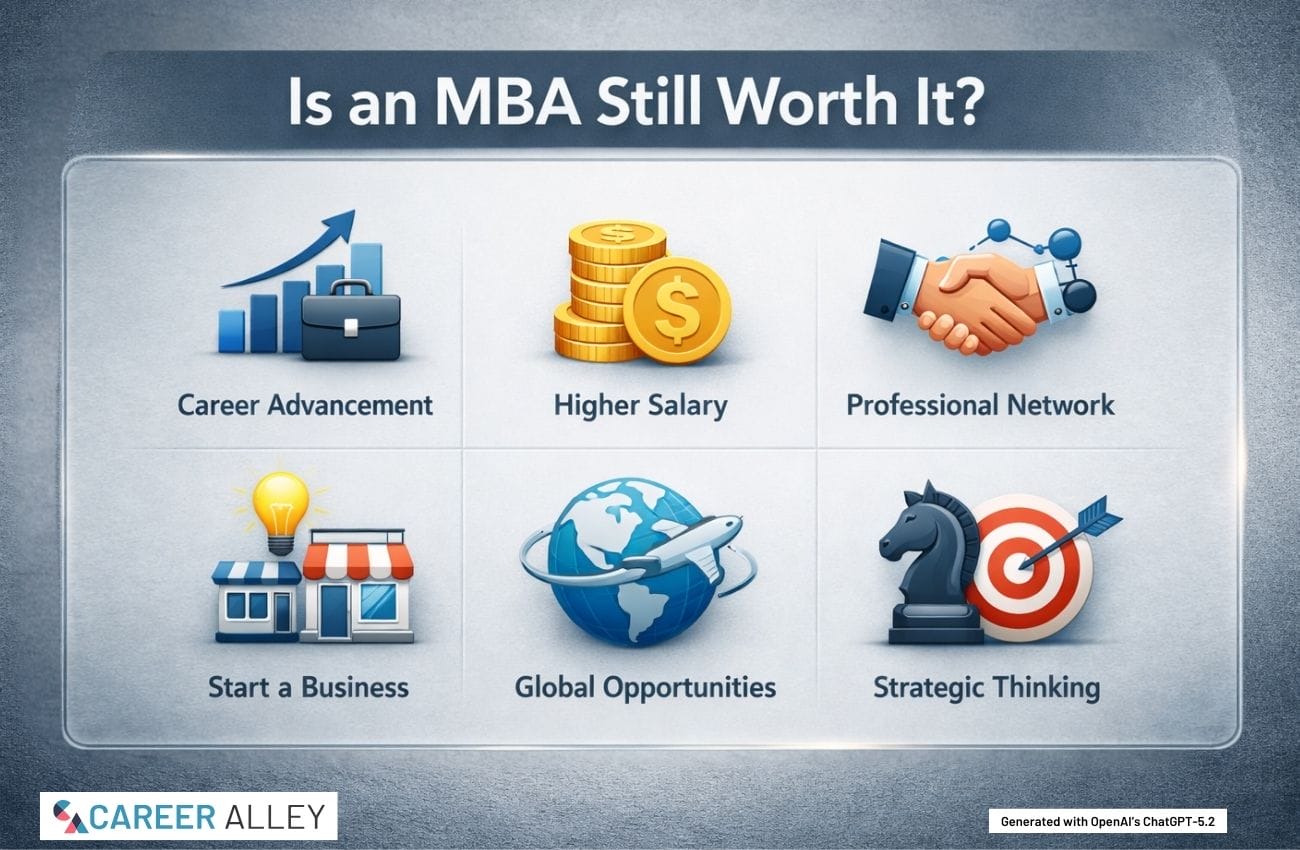
- Leadership and Management Readiness
- Income Potential and Return on Investment
- Professional Network Expansion
- Entrepreneurship and Business Ownership
- Global Career Mobility
- Critical Thinking and Strategic Decision-Making
- Further Guidance & Tools
- Next Steps
- Final Words
We may earn a commission if you click on a product link and make a purchase at no additional cost to you. For more information, please see our disclosure policy.
Last updated: March 2, 2026
By Mark Fiebert
Key Takeaways
- Enrollment Shift: MBA applications have rebounded in selective programs, but overall enrollment patterns reflect rising tuition costs and evolving employer skill demands.
- Salary Premium: Graduates from accredited programs continue to report strong compensation growth, especially in consulting, finance, and technology sectors.
- Leadership Development: MBA curricula build strategic thinking, decision-making, and executive communication skills essential for senior management roles.
- Entrepreneurial Edge: Structured exposure to finance, operations, and market strategy reduces startup risk and improves long-term business sustainability.
- Global Mobility: International coursework and alumni networks expand cross-border career opportunities and strengthen global business fluency.
Is an MBA Still Worth It in 2026?
Choosing the right post-secondary path has become more complex. While MBA enrollment in the United States declined after 2019, application volumes at many top-tier and specialized programs have stabilized or increased through 2025, according to recent reports from the Graduate Management Admission Council. The shift reflects changing candidate expectations rather than a decline in value.
Prospective students are more selective. Rising tuition, opportunity cost, and a competitive job market have forced candidates to scrutinize return on investment. Yet employers continue to recruit MBA graduates for leadership-track roles, particularly in consulting, private equity, corporate strategy, and technology management.
The question is no longer whether an MBA has value. The real question is whether it aligns with your goals, financial situation, and long-term career trajectory.

MBA Insider is exactly what it sounds like – an inside look at what goes on in an MBA Program, and how to make the most of the MBA experience to achieve your desired career growth.

What Is an MBA?
An MBA, or Master of Business Administration, is a graduate-level degree focused on advanced business management. Programs typically cover finance,
Accredited programs emphasize case-based learning, real-world simulations, and team collaboration. Students develop executive communication skills, leadership presence, and structured problem-solving frameworks that apply across industries.
For professionals seeking broader business fluency beyond a technical or specialized undergraduate degree, an MBA provides structured exposure to the full enterprise view of how organizations create value.
Leadership and Management Readiness
One of the strongest arguments for pursuing an MBA is preparation for management and senior leadership roles. Employers consistently rank strategic thinking, decision-making under uncertainty, and cross-functional collaboration among the most valuable executive skills.
MBA programs build these competencies through:
- Strategic analysis of complex business scenarios
- Financial modeling and capital allocation exercises
- Organizational leadership case studies
- Team-based problem solving
- Executive presentation training
Graduates leave with a clearer understanding of how finance, operations, and marketing decisions interact. That systems-level thinking is critical when managing budgets, leading departments, or driving corporate transformation initiatives.
For professionals targeting director, vice president, or C-suite pathways, the credential also signals formal leadership preparation to hiring committees and boards.

This ergonomic high-back mesh office chair offers adjustable comfort, foldable padded armrests, breathable back support, a cushioned seat, sturdy 300-pound capacity, and smooth 360-degree mobility for work or study.
Income Potential and Return on Investment
Compensation remains a primary motivator. According to recent GMAC and school-reported employment data for the Classes of 2024 and 2025, median base salaries for graduates of top U.S. MBA programs typically exceed $120,000, with total compensation significantly higher when signing bonuses and performance incentives are included.
Consulting and finance roles frequently report starting packages totaling over $150,000. Technology management positions remain highly competitive, particularly for graduates with analytics or product leadership experience.
That said, ROI varies dramatically by program quality, geographic region, and prior work experience. Tuition at leading private institutions can exceed $75,000 per year, excluding living expenses. Prospective students must evaluate:
- Total tuition and fees
- Lost income during full-time study
- Scholarship availability
- Career placement statistics
- Industry recruiting strength
Debt management is a serious consideration. Resources such as How to Get Out of Debt, Stay Out of Debt, and Live Prosperously provide useful frameworks for evaluating borrowing decisions. The right program can generate strong lifetime earnings growth, but poor financial planning can undermine those gains.

This third edition of Your MBA Game Plan includes even more sample essays and resumes from successful applicants, fresh insight into 35 leading business schools from around the world, and advice specifically tailored to international applicants.
Professional Network Expansion
An MBA cohort often becomes one of the most valuable long-term assets of the degree. Students collaborate with professionals from diverse industries, including engineering, finance, healthcare, military leadership, and technology.
Structured networking events, alumni mentorship programs, and recruiting partnerships with global firms create direct access to decision-makers. Alumni networks at established institutions span decades and frequently support career transitions, startup funding, and board appointments.
In many cases, job opportunities arise not from formal applications but from relationships developed during group projects, internships, and alumni events. The network effect compounds over time.
Entrepreneurship and Business Ownership
For aspiring founders, an MBA can reduce execution risk. Coursework in corporate finance, supply chain management, market research, and competitive strategy helps entrepreneurs avoid common early-stage mistakes.
Students often refine business models through structured incubators and pitch competitions. Access to professors, venture capital, guest speakers, and alumni founders can accelerate idea validation.
Practical exposure to financial forecasting and capital structuring is especially valuable when negotiating with investors or applying for funding. For entrepreneurs seeking structured preparation, resources such as The Portable MBA in Entrepreneurship Case Studies offer additional perspective.
While not mandatory for startup success, the degree provides frameworks that increase strategic discipline and operational clarity.

Slim Portfolio Folio Organizer Holder for Letter Legal A4 Note Pads Notebooks for Men Women Refillable Business Leather Portfolio Binder, Dark...
Global Career Mobility
Modern MBA programs emphasize international business exposure. Many schools integrate global consulting projects, exchange programs, or short-term study immersions in Asia, Europe, and emerging markets.
Cross-border trade, digital commerce, and multinational expansion require leaders who understand regulatory environments, currency risk, and cultural negotiation dynamics. Employers operating globally value graduates who demonstrate this competence.
For professionals targeting multinational corporations, international consulting firms, or overseas assignments, the MBA credential often enhances mobility and credibility.
Critical Thinking and Strategic Decision-Making
Beyond salary and networking, one of the most enduring benefits of an MBA is structured critical thinking. Programs train students to dissect ambiguous problems, analyze quantitative data, and defend strategic recommendations under scrutiny.
Team-based projects reinforce collaboration and communication skills. Executive simulations develop comfort with high-stakes decision environments. Over time, graduates build a disciplined approach to evaluating trade-offs, allocating capital, and managing risk.
These competencies extend far beyond corporate management. They apply to nonprofit leadership, public policy, consulting, and entrepreneurial ventures.

This book shatters stereotypes about people who dislike networking. They’re not shy or misanthropic. Rather, they tend to be reflective—they think before they talk.
Further Guidance & Tools
- GMAC Research: Explore current application trends and salary data through the GMAC market intelligence reports to evaluate program demand and ROI benchmarks.
- BLS Outlook: Review management occupation projections in the BLS management careers guide to understand long-term leadership demand across industries.
- AACSB Directory: Verify program accreditation using the AACSB accredited school directory to ensure academic quality and employer recognition.
- Harvard Business Review: Read leadership and strategy insights from Harvard Business Review to assess real-world executive challenges MBA graduates face.
- Federal Student Aid: Compare financing options through the Federal Student Aid portal to understand loan terms, repayment plans, and borrowing limits.
Next Steps
- Clarify Goals: Define whether you seek promotion, industry transition, entrepreneurship, or global mobility before evaluating specific MBA formats.
- Calculate ROI: Compare tuition, living costs, scholarships, and projected post-graduation compensation to determine realistic payback timelines.
- Research Programs: Focus on accredited schools with strong placement records in your target industry rather than relying solely on brand prestige.
- Speak to Alumni: Conduct informational interviews with recent graduates to understand career outcomes and cultural fit.
- Assess Alternatives: Consider part-time, executive, or specialized master’s programs if full-time enrollment does not align with your financial or career situation.

A versatile bamboo desk organizer with expandable storage, multiple compartments, and drawers, designed to reduce clutter while keeping office supplies, papers, and accessories neatly organized.
Final Words
An MBA remains a powerful credential when pursued strategically. Its value depends on alignment with your career objectives, financial planning, and willingness to leverage the network and skills gained. For professionals targeting leadership, entrepreneurship, or global mobility, the degree can accelerate growth and expand opportunity. The decision should be analytical, not emotional. When chosen deliberately and executed with purpose, an MBA can still deliver substantial long-term returns.
MBA Insider is exactly what it sounds like – an inside look at what goes on in an MBA Program, and how to make the most of the MBA experience to achieve your desired career growth.

Mark Fiebert is a former finance executive who hired and managed dozens of professionals during his 30-plus-year career. He now shares expert job search, resume, and career advice on CareerAlley.com.