

- Key Takeaways
- Firefighter: Emergency Response and Public Safety
- Fire Marshal and Fire Investigator: Prevention and Investigation
- Welder: Building and Repairing with Heat
- Blacksmith: Traditional Metalworking and Modern Craftsmanship
- Glassblower: Combining Art, Science, and Heat
- Live-Fire Cook: Culinary Careers Using Open Flames
- How to Choose the Right Fire-Related Career
- Training, Certifications, and Safety
- Professional Recognition and Fire Service Traditions
- Further Guidance & Tools
- Next Steps
- Final Words
We may earn a commission if you click on a product link and make a purchase at no additional cost to you. For more information, please see our disclosure policy.
Last updated: October 8, 2026
Key Takeaways
- Different Career Paths: Careers involving fire include emergency response, fire prevention, metalworking, glassmaking, and cooking, with substantially different responsibilities and working environments.
- Training Requirements: Firefighters typically complete academy training, while welders and skilled craftspeople may enter through technical programs, apprenticeships, or supervised experience.
- Safety Considerations: Working with heat, flames, or molten materials creates occupational hazards, making proper equipment, technical knowledge, and established safety procedures essential.
- Earning Potential: Fire inspection and investigation generally offer higher median wages than many entry-level culinary positions, although compensation varies considerably by location and experience.
- Choosing a Career: The strongest choice depends on whether you prefer public service, technical problem-solving, creative craftsmanship, or food preparation and hospitality.
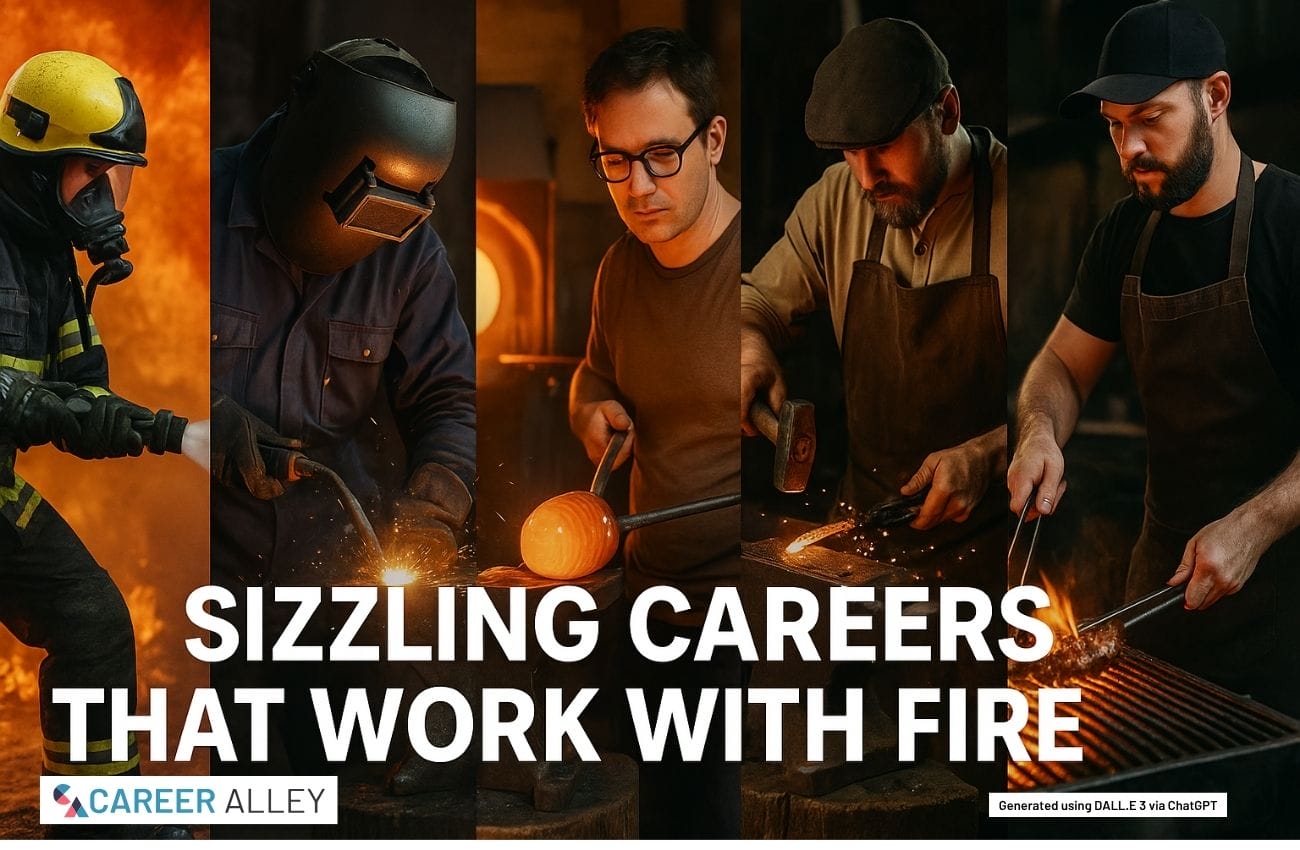
Working with fire can mean entering a burning building, investigating a suspicious blaze, joining industrial metals, or shaping molten glass into finished products. Although these occupations involve heat or flames, they require very different skills, qualifications, and working conditions.
For someone exploring a hands-on career, the key distinction isn’t simply whether a job involves fire. It is how that work matches your interests, physical capabilities, risk tolerance, and long-term career goals.
Some occupations offer structured employment with government agencies or established manufacturers. Others provide opportunities for creative independence or business ownership. Understanding these differences can help you identify a realistic
Firefighter: Emergency Response and Public Safety
Firefighting is one of the most recognizable careers involving fire, but extinguishing flames represents only part of the job. Firefighters also respond to vehicle accidents, medical emergencies, hazardous-material incidents, and other situations threatening public safety.
Depending on their department and assignment, firefighters operate emergency equipment, conduct rescues, provide emergency medical assistance, inspect equipment, and participate in training exercises.
A career as a firefighter can appeal to people who enjoy teamwork, physical activity, public service, and making decisions under pressure.
However, prospective firefighters should consider the less glamorous responsibilities. Maintaining equipment, completing reports, cleaning facilities, and participating in repeated training exercises are important parts of the work.
Firefighters also encounter physically demanding situations, unpredictable emergencies, and potentially traumatic events. Depending on the department, their schedules may include extended shifts, overnight assignments, weekends, and holidays.
Firefighters must develop more than the technical skills needed to pass an academy examination. Physical conditioning, communication, judgment, teamwork, and familiarity with departmental procedures all contribute to effective performance.
Entry requirements vary by department and jurisdiction. Applicants generally need a high school diploma or equivalent, and many departments require emergency medical technician certification or other qualifications. Candidates may also face written examinations, physical ability testing, background checks, and medical evaluations.
According to the U.S. Bureau of Labor Statistics, the median annual wage for firefighters was $59,280 in May 2025. Actual earnings depend on location, department, seniority, responsibilities, and overtime.
Applicants preparing for department-specific examinations should review the hiring requirements before purchasing preparation materials. Resources such as Firefighter test preparation may be useful when the materials correspond to the examinations an applicant will actually take.
Fire Marshal and Fire Investigator: Prevention and Investigation
Fire marshals, fire inspectors, and fire investigators concentrate on preventing fires, enforcing applicable safety requirements, and determining how fires begin. Although these responsibilities sometimes overlap, the positions are not interchangeable.
A fire inspector typically examines buildings for fire hazards, checks compliance with relevant fire codes, and identifies conditions requiring correction. Fire marshals may supervise prevention programs, oversee inspections, investigate incidents, or enforce regulations, depending on their jurisdiction.
Fire investigators examine damaged structures, physical evidence, witness statements, and other information to determine a fire’s origin and cause. An arson investigator may focus on incidents involving suspected criminal activity.
These occupations can appeal to firefighters seeking to move into prevention or investigative assignments.
Some fire marshals have law enforcement responsibilities, including investigative authority or arrest powers. However, those powers are not universal and depend on state and local law.
For someone interested in combining emergency services with analytical work, fire investigation may be an ideal career direction, particularly when it builds on previous experience in firefighting, engineering, inspection, or criminal investigation.
According to the Bureau of Labor Statistics, fire inspectors and investigators earned a combined median annual wage of $75,920 in May 2025. This occupational category includes different positions, so the figure should not be interpreted as the typical salary for every fire marshal or arson investigator.
Many fire inspectors and investigators enter the occupation after gaining experience as firefighters or in related roles. Additional education, specialized training, and professional certification may be required or preferred.
Investigative work also demands careful documentation and evidence-based conclusions. A fire’s appearance alone does not prove arson. Investigators must consider accidental causes, relevant fire science, physical evidence, and the limitations of available information.
Welder: Building and Repairing with Heat
Welding offers a practical path into manufacturing, construction, infrastructure maintenance, and industrial repair. Unlike firefighting, the objective is not to extinguish flames but to use controlled heat and other processes to join or repair materials.
Welders work with metals using processes that may involve electric arcs, fuel gases, or other heat sources. Common applications include structural steel fabrication, vehicle repair, industrial equipment maintenance, and pipeline construction.
Welding is particularly attractive to individuals who enjoy precise technical work and producing tangible results. However, it requires patience, consistent technique, and an understanding of how materials behave under heat.
Typical responsibilities include:
- Reading drawings, specifications, and welding instructions.
- Preparing and positioning metal components.
- Selecting appropriate welding techniques and equipment.
- Inspecting completed joints for defects.
- Following procedures designed to protect workers and nearby equipment.
Most welders enter through technical education, employer training, apprenticeships, or combinations of these approaches. Some employers require specific certifications or demonstrated proficiency with particular welding processes.
Specialization can create additional opportunities. Workers who develop advanced skills in pipe welding, precision fabrication, underwater welding, or specialized industrial applications may qualify for positions requiring additional training and experience.
However, attractive advertised salaries can be misleading when they include extensive overtime, travel allowances, unusual working conditions, or highly specialized qualifications.
The Bureau of Labor Statistics reported a median annual wage of approximately $51,000 for welders, cutters, solderers, and brazers in May 2025. Earnings vary by industry, geographic location, skill level, and employment arrangement.
Welding also involves important occupational health considerations. The Occupational Safety and Health Administration identifies exposure to metal fumes, ultraviolet radiation, burns, electric shock, and other hazards associated with welding and cutting operations.
Proper ventilation, appropriate respiratory protection, eye protection, protective clothing, and established workplace safety procedures remain essential. Modern equipment can reduce certain risks, but it does not eliminate them.
Blacksmith: Traditional Metalworking and Modern Craftsmanship
Blacksmithing combines technical metalworking with craftsmanship and design. A blacksmith heats metal until it becomes workable and then shapes it using hammers, anvils, presses, and other tools.
Blacksmiths may produce decorative architectural components, gates, tools, hardware, furniture elements, and commissioned metalwork. Some specialize in historical restoration, traditional forging techniques, or artistic pieces.
The occupation appeals to people who enjoy creative problem-solving, physical craftsmanship, and working with hand tools.
Blacksmithing differs from most industrial welding positions because many practitioners work in small workshops, specialized businesses, or independent studios rather than large manufacturing environments.
That independence offers creative flexibility but also introduces business responsibilities. A self-employed blacksmith may need to:
- Estimate material costs and project labor.
- Purchase and maintain specialized equipment.
- Develop custom designs and communicate with customers.
- Photograph completed projects and maintain a portfolio.
- Market services and manage business finances.
Many aspiring blacksmiths begin with introductory workshops, community education programs, or instruction from experienced craftspeople. Learning basic forging techniques before investing in expensive equipment can help determine whether the work is a good fit.
Because blacksmithing employment arrangements vary considerably, broad salary estimates are less useful than evaluating actual job opportunities, workshop earnings, or the economics of a particular business.
For someone considering self-employment, the central challenge is not merely becoming proficient at forging metal. It is determining whether customers will consistently pay enough for the finished work to cover materials, equipment, overhead, and labor.
Glassblower: Combining Art, Science, and Heat
Glassblowing offers another creative occupation built around high temperatures. Glassworkers heat glass until it becomes sufficiently pliable to shape, bend, join, or form into finished objects.
Although artistic glassblowing receives considerable attention, glassworking also supports industrial, laboratory, and specialized manufacturing applications.
These career directions differ in meaningful ways.
Artistic glassblowing emphasizes original designs, decorative objects, functional art, and customized pieces. Artists may work independently, collaborate in studios, sell through galleries, or teach classes.
Scientific glassworking involves creating, modifying, or repairing specialized glass apparatus used in laboratories and technical settings. This work emphasizes precision, dimensional accuracy, material properties, and scientific equipment requirements.
Production glassworking may involve manufacturing processes, repetitive techniques, quality control, and producing standardized items.
The U.S. Department of Labor’s O*NET occupational database identifies glass blowers, molders, benders, and finishers as workers who shape molten or heated glass using specialized equipment and techniques.
Entry routes vary. Artistic glassworkers may begin through studio classes, college programs, apprenticeships, or direct instruction. More technical positions may require specialized training and experience with particular materials and equipment.
Prospective glassblowers should consider equipment costs, studio access, protective supplies, and ongoing material costs. Independent artists also need to develop the business skills required to sell their work.
For someone interested primarily in creativity, studio glassblowing may be appealing. Individuals who prefer precision manufacturing or technical applications may find scientific or industrial glassworking a better match.
Live-Fire Cook: Culinary Careers Using Open Flames
Professional cooking offers another way to work directly with fire, particularly in restaurants specializing in barbecue, wood-fired ovens, grilling, or open-flame cooking.
Unlike firefighting or metalworking, culinary careers use heat to prepare food while balancing flavor, cooking temperatures, timing, presentation, and food safety.
Live-fire cooking can involve several specialties:
- Grill Cooking: Preparing meat, seafood, vegetables, and other foods over controlled heat.
- Barbecue: Managing fuel, smoke, temperature, and cooking time, sometimes over many hours.
- Wood-Fired Baking: Operating specialized ovens used for pizza, bread, and other baked products.
- Open-Fire Cooking: Preparing food using direct flames, embers, or specialized outdoor cooking equipment.
Many cooks start in entry-level kitchen positions and build skills through supervised work. Culinary school can provide structured instruction, but it is not required to enter professional cooking.
For someone exploring the specialty, Basic line cook jobs can provide practical exposure to kitchen operations, food preparation, and professional cooking techniques before pursuing more specialized responsibilities.
According to the Bureau of Labor Statistics, the median annual wage for cooks was $36,640 in May 2025. Chefs and head cooks, whose responsibilities generally include managing food preparation and supervising kitchen operations, earned a median annual wage of $62,470.
These figures represent broad occupational categories rather than earnings specific to live-fire cooking.
Restaurant work can be physically demanding and frequently involves evenings, weekends, holidays, and extended periods of standing. Workers must also manage burn risks, sanitation requirements, equipment maintenance, and food safety.
For people considering restaurant ownership, strong cooking skills are only one part of the equation. Labor costs, food costs, pricing, customer demand, and operating expenses can determine whether a business succeeds.
How to Choose the Right Fire-Related Career
These occupations share exposure to heat or flames, but their working environments, training requirements, and long-term opportunities differ substantially.
The most useful comparison begins with the type of work you would enjoy performing regularly, including the routine responsibilities that receive less attention than the occupation’s most dramatic moments.
Choose firefighting if: You value public service, emergency response, physical activity, and close teamwork. You must also be prepared for unpredictable schedules and potentially hazardous situations.
Consider fire inspection or investigation if: You enjoy examining evidence, interpreting requirements, documenting findings, and solving technical problems. Experience in firefighting or another relevant field can provide an important foundation.
Explore welding if: You prefer technical work, precise procedures, and established employment opportunities in construction, manufacturing, or industrial maintenance.
Consider blacksmithing if: You enjoy traditional craftsmanship, design, and producing custom objects. Be prepared to evaluate the financial realities of small-business ownership if you want to work independently.
Explore glassworking if: You enjoy the intersection of creativity, technical precision, and hands-on production. Decide whether artistic, scientific, or industrial applications interest you most.
Consider live-fire cooking if: You enjoy preparing food, working in fast-paced environments, and developing specialized culinary techniques. Advancement usually depends on demonstrated skill, experience, and taking on more responsibility.
Another useful consideration is whether you want predictable employment or the potential to earn independently.
Government fire departments and established manufacturers may offer defined employment structures, although hiring can be competitive and schedules may be demanding. Independent artisans and culinary entrepreneurs may have greater creative control but also face uncertain revenue and business expenses.
It is also worth distinguishing occupational interest from actual job fit. Someone fascinated by fire investigation may not enjoy extensive documentation. Someone drawn to blacksmithing may find customer acquisition and pricing less appealing than forging metal.
Whenever possible, observe the work firsthand before committing to substantial training expenses.
Training, Certifications, and Safety
Fire-related careers generally require some combination of technical training, supervised experience, and safety instruction. However, entry qualifications differ significantly.
Firefighters frequently attend structured academies and complete department-specific testing. Fire inspectors and investigators may need previous occupational experience and specialized credentials.
Welders can enter through technical schools, employer-sponsored training, or an apprenticeship. Blacksmiths and glassworkers often develop their abilities through studio instruction and practical experience, while cooks typically learn through workplace training, culinary education, or both.
Before enrolling in a program, determine whether a credential is legally required, required by an employer, preferred for hiring, or simply helpful for developing skills.
This distinction matters because a training program can be expensive without necessarily improving eligibility for a particular position.
Ask prospective training providers about employer relationships, practical instruction, equipment access, total costs, and the qualifications graduates receive.
Safety should also influence career decisions. Depending on the occupation, hazards can include burns, smoke exposure, airborne contaminants, intense radiant energy, heavy equipment, and physically strenuous conditions.
Training should address work-specific risks rather than relying on general safety instruction alone.
Professional Recognition and Fire Service Traditions
Fire-related occupations also have professional communities and traditions that extend beyond everyday work.
International Firefighters’ Day is observed annually on May 4. It originated in Australia following the deaths of firefighters in a 1998 wildfire and developed into an international occasion to recognize firefighters’ service and remember those who died in the line of duty.
Fire departments and community organizations may commemorate the occasion through ceremonies, educational activities, and recognition events.
Commemorative items sometimes include firefighter challenge coins and custom lapel pins that recognize service, commemorate important events, or acknowledge individual accomplishments.
For prospective firefighters, participating in community events or speaking with department personnel can also provide insight into the profession’s culture, expectations, and public-service responsibilities.
Further Guidance & Tools
- Career Outlook: Consult the Bureau of Labor Statistics for firefighter pay, education requirements, working conditions, and employment projections.
- Apprenticeship Opportunities: Use Apprenticeship.gov to explore paid training opportunities and understand how registered apprenticeship programs operate.
- Occupational Details: Explore O*NET’s glassworking occupation profile to examine typical tasks, skills, work activities, and occupational requirements.
- Workplace Safety: Review OSHA’s welding safety guidance for information about common hazards and protective measures associated with welding and cutting.
Next Steps
- Identify Preferences: Decide whether emergency response, technical production, investigation, creative craftsmanship, or culinary work best matches your interests and abilities.
- Compare Requirements: Research local employers and training providers to identify required credentials, entry qualifications, physical demands, and realistic starting compensation.
- Observe Professionals: Contact departments, workshops, studios, or restaurants about informational interviews, demonstrations, introductory classes, or appropriate job-shadowing opportunities.
- Evaluate Costs: Compare tuition, equipment expenses, training duration, and potential earnings before committing financially to a particular
career path . - Build Experience: Pursue an appropriate introductory course, supervised training opportunity, apprenticeship, or entry-level position to test your interest and develop skills.
Final Words
Choosing a career involving fire requires looking beyond the excitement of working with powerful or dangerous materials. The daily responsibilities, required training, employment conditions, and opportunities for advancement matter far more than the dramatic aspects of the work. A firefighter’s commitment to public service differs substantially from a welder’s technical precision or a glassblower’s creative process. Before investing in training, take time to understand what professionals actually do, what employers expect, and how the work fits your long-term financial and personal priorities. That preparation can help turn an unusual occupational interest into a sustainable career.
From timeless classics that provide foundational career advice, to modern masterpieces decoding today's job market, our curated list of career-focused books offers invaluable insights. Whether you're a fresh graduate, a seasoned professional seeking growth, or anywhere in between, these books promise to enlighten, inspire, and guide you toward career success.



Mark Fiebert is a former finance executive who hired and managed dozens of professionals during his 30-plus-year career. He now shares expert job search, resume, and career advice on CareerAlley.com.

